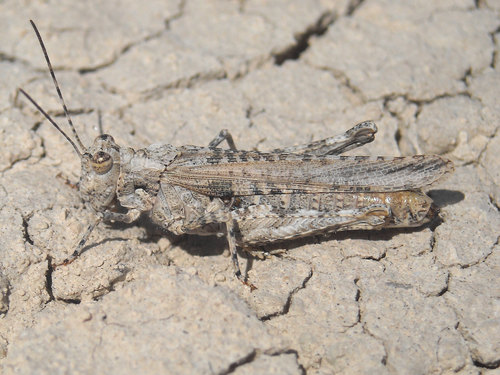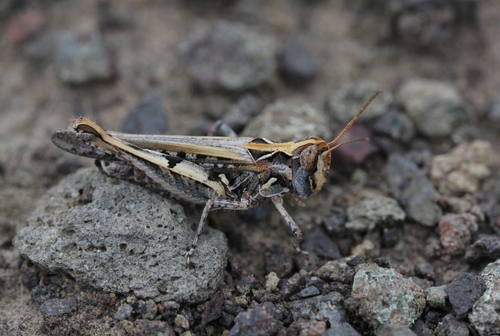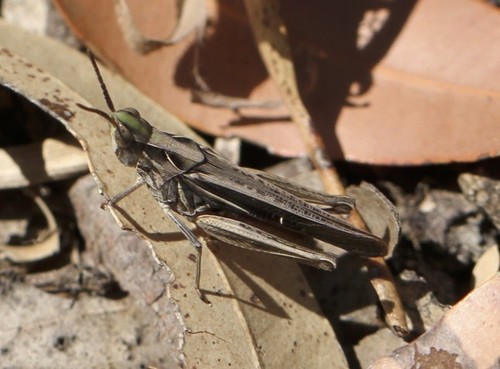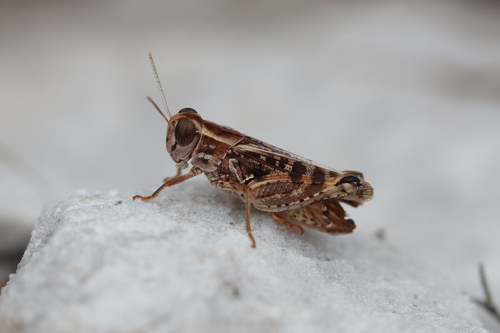
About Schistocerca gregaria (Forskål, 1775)
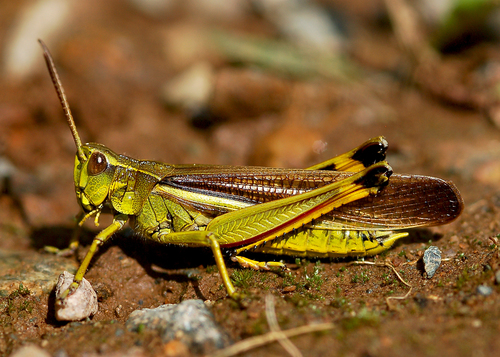
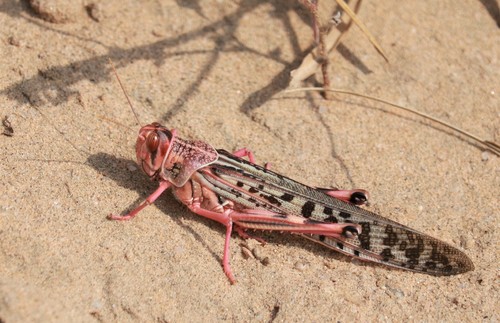
The genus Schistocerca includes more than 30 species distributed across Africa, Asia, North America, and South America. Many species are hard to identify because they have multiple variable morphs. Schistocerca is the only genus within the subfamily Cyrtacanthacridinae that occurs in both the New World and Old World. Most Schistocerca species have a deflexed fastigium and lack lateral carinae on the pronotum. The hind tibiae have smooth margins with numerous spines, but no apical spine on the outer margin. Males of the genus have broad anal cerci and a split subgenital plate. The genus is thought to have originated in Africa, then diversified into new species in the New World after a dispersal event that occurred 6 to 7 million years ago. The morphology and colour of Schistocerca gregaria, the desert locust, differs based on whether individuals are in the solitary or gregarious phase. Adult body size varies by phase and sex: solitary females are 6–9 cm long, solitary males are 4.5–6 cm long, gregarious females are 5–6 cm long, and gregarious males are 4.5–5 cm long. The prosternal tubercle is straight, blunt, and slightly sloped backwards. The male subgenital plate is bilobed, and the cerci are flat and blunt. The elytra have large irregular spots. Gregarious-phase adults have a narrower, saddle-shaped pronotum that does not form a crest. The eyes have visible striae; the number of striae increases after each moult, and striae are only clearly visible in solitary individuals. Nymph coloration and development differ by phase: solitary nymphs are greenish or pale beige and may go through six instars, while gregarious nymphs are typically yellow with a black head, black pronotum, and black lateral stripes on the abdomen, going through five instars. First-instar gregarious nymphs are almost entirely black. Immature solitary adults are sandy, pale grey, or beige. Mature solitary males become pale yellow, while mature solitary females become pale beige with brown patterns. Immature gregarious adults are pink to reddish, changing to bright yellow in mature males. Mature gregarious females have less bright yellow that is mainly found on the upper parts of the body, with lower parts being pale beige. The hindwings are transparent or pale yellow. Desert locusts exhibit polyphenism, with distinct solitary and gregarious phases. When placed in crowded conditions, solitary nymphs and adults can switch to gregarious behaviour within a few hours. When reared in isolation, gregarious locusts require one or more generations to return to the solitary phase. Morphological and behavioural differences exist between the two phases. In the solitary phase, hoppers do not form groups, moving independently. Later instars have greenish or brownish colouring that matches surrounding vegetation. Solitary adults fly at night and have camouflage colouring, with immature adults being grey or beige and mature adults being pale yellowish. In the gregarious phase, hoppers cluster together. Later instars develop bold colouration with black markings on a yellow background. Immature gregarious adults are pink, mature gregarious adults are bright yellow, and they fly during the day in dense swarms. The shift from harmless solitary insects to voracious gregarious ones usually occurs after a period of drought, when rain falls and new vegetation grows in major desert locust breeding areas. This allows populations to grow rapidly and increases competition for food. As hoppers become more crowded, repeated physical contact causes their hind legs to bump against one another. This stimulus triggers a cascade of metabolic and behavioural changes that transform the insects from the solitary to gregarious phase. Once hoppers become gregarious, their colour shifts from mostly green to yellow and black, while adults change from brown to pink (if immature) or yellow (if mature). Their bodies become shorter, and they release a pheromone that makes individuals attracted to one another, encouraging the formation of hopper bands and eventually swarms. The nymphal pheromone is different from the adult pheromone. When exposed to the adult pheromone, hoppers become confused and disoriented, because they apparently can no longer detect each other's scent, even though visual and tactile stimuli still remain. After a few days, hopper bands break apart, and any individuals that avoid predation return to a solitary lifestyle. During quiet periods called recessions, desert locusts are restricted to a 16-million-square-kilometre (6.2-million-square-mile) belt that stretches from Mauritania through the Sahara Desert in northern Africa, across the Arabian Peninsula, and into northwest India. Under favourable ecological and climatic conditions, several successive generations can develop, leading to swarm formation. Swarms invade countries surrounding the recession area, reaching as far north as Spain and Russia, as far south as Nigeria and Kenya, and as far east as India and southwest Asia. Up to 60 countries can be affected across an area of 32 million square kilometres (12 million square miles), roughly 20% of the Earth's total land surface. Locust swarms travel with the wind at approximately wind speed. They can cover 100 to 200 km (62 to 124 mi) in a single day, and fly up to around 2,000 metres (6,600 ft) above sea level, as temperatures become too cold at higher altitudes. For this reason, swarms cannot cross tall mountain ranges such as the Atlas, Hindu Kush, or Himalayas. They do not enter African rain forests, nor do they reach central Europe. However, adult locusts and entire swarms regularly cross the Red Sea between Africa and the Arabian Peninsula, and there is even a report of a crossing of the Atlantic Ocean from Africa to the Caribbean over 10 days during the 1987–88 plague. A single swarm can cover up to 1,200 square kilometres (460 sq mi) and contain between 40 and 80 million locusts per square kilometre (100 million to 210 million per square mile). This adds up to around 50 to 100 billion locusts per swarm, or 100,000 to 200,000 metric tons assuming an average individual mass of 2 grams. Desert locusts have a lifespan of 3 to 6 months, and locust numbers can increase 10- to 16-fold from one generation to the next.