About Schinus molle L.
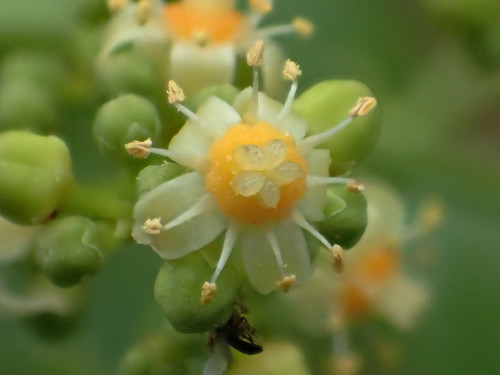
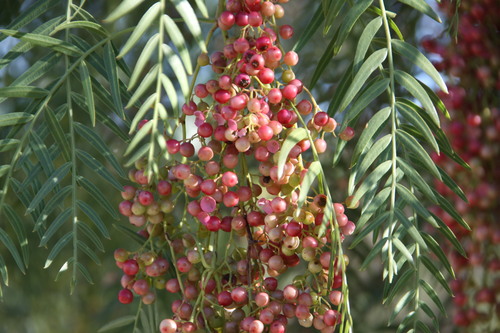
Schinus molle L. is a fast-growing evergreen tree that reaches up to 15 meters (50 feet) tall and wide. It is the largest and potentially longest-lived species in the Schinus genus. Its upper branches typically droop. The tree produces pinnately compound leaves that measure 8 to 25 cm long and 4 to 9 cm wide, made up of 19 to 41 alternate leaflets. This species is dioecious, meaning male and female flowers grow on separate individual plants. The small, white flowers grow in large quantities in panicles at the ends of the drooping branches. The fruit are round drupes 5 to 7 mm in diameter, containing woody seeds; they change color from green to red, pink, or purplish, and are held in dense clusters of hundreds of berries that can be present year-round. The tree’s rough grayish bark is twisted and oozes sap. When crushed, the bark, leaves, and berries release an aromatic scent. Schinus molle is native to the arid zone of northern South America, including Peru’s Andean deserts, with its native range extending to central Argentina and central Chile. It has since become widely naturalized across much of the world. Its strong wood was used to make saddles, and it was a key supply source for saddles in Spanish colonies. It has also been used for spice production, but it is primarily planted as an ornamental tree. This is a drought-tolerant, long-lived, hardy evergreen species that has become a serious invasive weed internationally. For example, in South Africa, it has invaded savannas and grasslands, and naturalized along drainage lines and roadsides in semi-desert areas. It is also invasive across much of Australia, in habitats ranging from grasslands to dry open forest and coastal areas, as well as on railway sidings and abandoned farms. In traditional medicine, Schinus molle has been used to treat a wide range of wounds and infections, due to its antibacterial and antiseptic properties. It has also been used as an antidepressant and diuretic, and to treat toothache, rheumatism, and menstrual disorders; recent mouse studies provide possible support for its antidepressant effects. Its insecticidal properties have led to speculation that it could be a good alternative to synthetic chemical pest control. Bunches of fresh green leaves are used in shamanic practices in traditional Mesoamerican cleansing and blessing ceremonies. In the Andean region, the leaves are used to produce natural dye for textiles; this practice dates back to pre-Columbian times. The Incas used oil from its leaves in early mummification practices to preserve and embalm their dead. Schinus molle is also used as a raw material in perfumery. There is archaeological evidence that the Wari state of the Middle Horizon (600–1000 AD) used the drupes of S. molle extensively to produce chicha, a fermented alcoholic beverage. Excavations at the Quilcapampa site in southern Peru found evidence the Wari combined vilca tree (Anadenanthera colubrina) seeds, a hallucinogenic drug, with this chicha. The Inca used the sweet outer layer of ripe fruit to make a drink: berries were rubbed carefully to avoid mixing in the bitter inner parts, the mixture was strained, then left to ferment for a few days. The fruit was also boiled down to make syrup, or mixed with maize to make nourishing gruel. In the late 19th century, Schinus molle was widely planted in California and became commonly known as the "California pepper tree". It gained romantic associations linked to the state’s Spanish missions; by the 1870s, "the pepper tree had become as familiar a visual trope as the padres' sandals and staffs." It was also valued for its shade and tolerance of semi-arid conditions, so it was planted along new avenues in Southern California’s cities. In 1911, a Los Angeles Times editorial praised the tree: "One of the first features to grip the eastern tourist when visiting this favored winter resort is the wonderful feathery foliage and the gorgeous scarlet berries of this matchless shade tree, giving, as it does, a pleasant air of holiday making and a wealth of tropical color to the Californian landscape...Why, the pepper tree has become an integral part of life in the sunny Southland." However, Schinus molle fell out of favor as a street tree in the early 20th century, in part because it hosts black scale, an insect that threatened Southern California’s citrus groves. The trees’ roots also tend to break apart sidewalks, the species produces suckers, and its growth can interfere with buried telephone lines and sewer pipes. Many of the oldest trees were uprooted, and new street plantings were banned in citrus-growing areas; Los Angeles banned new street plantings of the species in 1930. This tree can reproduce through seeds, suckers, and cuttings. Its seeds have an especially hard coat, and germination rates improve greatly after the seeds pass through the gut of birds or other animals. Seeds germinate in spring, and seedlings grow slowly until they are fully established. Hundreds of seeds can easily germinate under the parent tree in its existing leaf litter, and the resulting seedlings can be readily transplanted.