About Sceloporus graciosus Baird & Girard, 1852
Nomenclature
This species, commonly called the sagebrush lizard, has the scientific name Sceloporus graciosus Baird & Girard, 1852.
Size & Similar Species
When fully grown, the sagebrush lizard typically measures 4.7–8.9 cm (1.9–3.5 in) in snout-to-vent length (SVL), while newly hatched lizards are approximately 25 mm (0.98 in) SVL. It closely resembles the western fence lizard, but is typically smaller and has a greater number of scales.
Dorsal & Lateral Markings
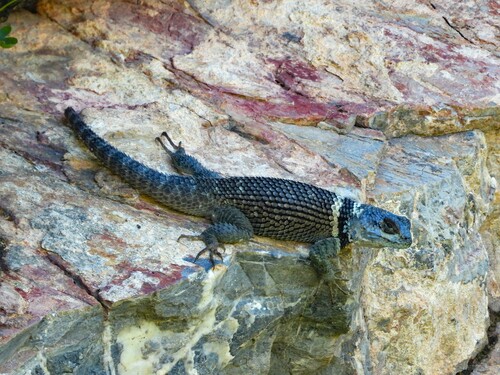
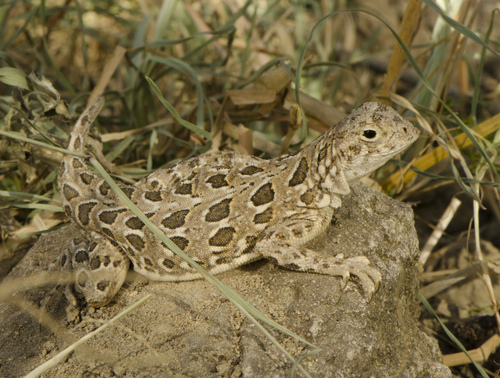
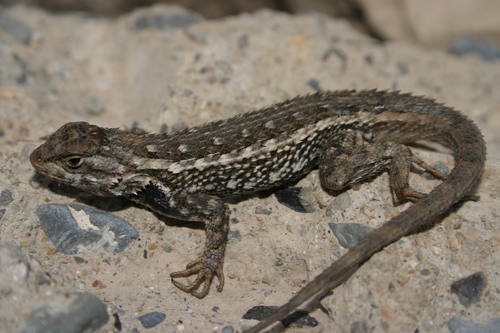
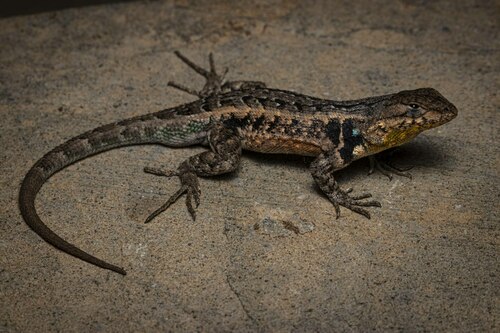
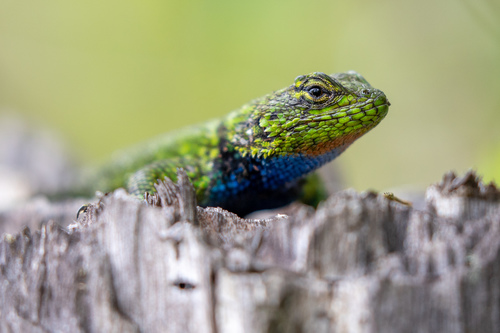
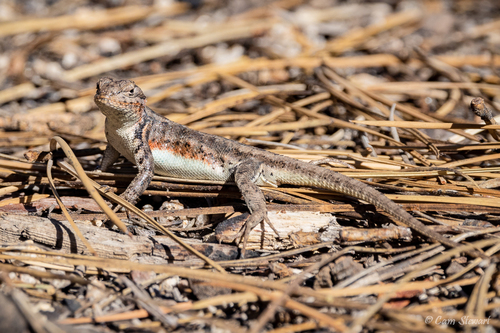
Sagebrush lizards have a base coloration of grey, brown, or olive, with blue or green tints on the dorsal surface during the light phase, and often have irregular banding on the body and tail. They frequently have a black bar on the shoulder, and light lateral and dorsolateral lines running along both sides of the body.
Ventral & Scale Traits
Scales on the rear portion of the thigh are small and granular, and the armpit and lateral body surface are often rust-colored. Females have white or yellow bellies, while males have distinct blue patches on the abdomen and throat (the throat patch may sometimes be absent).
Sexual & Juvenile Traits
Males also have enlarged postanal scales and two swollen areas at the base of the tail, and may develop orange breeding coloration during the breeding season. Young lizards resemble adults, but do not have the dark blue markings of mature individuals.
Geographic Range
The geographic range of S. graciosus covers most of the western United States. It occurs throughout Utah, Nevada, southern Idaho, northern Arizona, northwestern New Mexico, Texas, and western Colorado, and is also widely distributed across parts of Wyoming, Oregon, California, Washington, western North Dakota, South Dakota, and Nebraska.
Elevation & Size Variation
Sagebrush lizards live at elevations ranging from 500 to 10,500 ft (150 to 3,200 m). Within the sagebrush lizard population, body size shows geographic variation, which is hypothesized to be influenced by thermal constraints.
Growth Drivers Hypothesis
In general, longer seasonal activity is associated with larger adult body size, which comes from increased lizard growth due to more time spent foraging. These growth differences can also be explained by biophysical constraints on foraging activity, food availability, or thermal constraints that cause variation in net energy assimilation.
Thermal Constraint Study Findings
A study by Michael Sears published in the paper "Geographic variation in the life history of the sagebrush lizard: the role of thermal constraints on activity" found that sagebrush lizard growth patterns do not depend solely on thermal constraints. If reduced thermal activity opportunity (as found at high elevations) were the only determining factor, high elevation lizards would have smaller adult body sizes.
High Elevation Traits
However, sagebrush lizards at high elevations grow faster despite shorter seasonal activity and cooler environmental temperatures. High elevation lizards also face a higher mortality risk.
Food Availability Impact
To explain why growth rates do not increase alongside increased thermal activity opportunity, it is important to note that food availability is correlated with growth. Food availability and individual lizard access to food are difficult to analyze.
Food Adaptations & Access
Sagebrush lizards are physiologically better adapted to lower food levels, as they have lower lipid utilization and extract more usable energy for metabolism from their food sources. Intraspecific interactions can also limit an individual's access to food.
Thermoregulation Tradeoffs
Additionally, the spatial distribution of operative environmental temperatures for lizards constrains the time they can be active. These lizards use radiant energy to raise their body temperatures, so time spent thermoregulating in microhabitats takes away from time available for foraging, courtship, and predator avoidance.
Habitat Preferences
The sagebrush lizard is most commonly found in shrublands, but also occurs in a variety of other habitats including coniferous forests and piñon-juniper woodlands. They bask on logs and rocky outcrops.
Predator Escape & Territoriality
Most of their time is spent on the ground, but they are capable of climbing to escape predators. Males defend territories both during and after the breeding season, through posturing and physical combat.
Courtship Behavior
Male and female territories overlap, allowing males to court and mate with a small number of familiar females. Courtship involves head bobbing and shudder displays, and is physically demanding and time-consuming.
Mating Season Traits
Males are usually slightly larger than females. Sagebrush lizards mate in the spring.
Egg Laying & Incubation
They produce one or two clutches containing two to ten eggs, laid between late spring and midsummer approximately 1 inch (2.5 cm) deep in loose soil, usually at the base of a shrub. Eggs hatch after 45–75 days (around two months).
Reproductive Variation & Maturity
Females in the northwestern part of the range may produce two clutches. Young lizards reach sexual maturity in their first year if they are from the southern range, or in their second year if they are from the northern range.