About Scaptotrigona postica (Latreille, 1807)
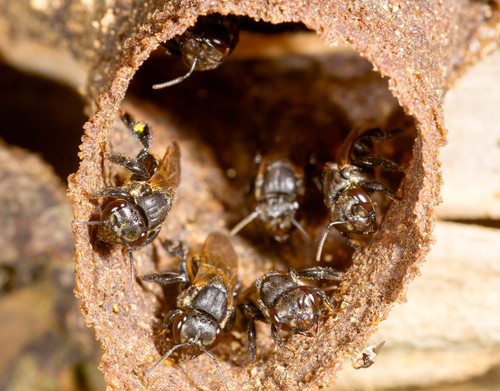
Scaptotrigona postica, known locally as mandaguari in Brazil, is a species of stingless eusocial bee in the tribe Meliponini. It is one of 25 species in the genus Scaptotrigona, and lives mainly in Brazil. This species is a critical pollinator of Brazil's tropical rain forests. S. postica constructs nests in hollowed sections of tree trunks, an arrangement that supports effective guarding at the nest entrance. Its colony structure matches that of most members of the Meliponini tribe, with three distinct roles within the colony: queen, worker, and male. Individuals of S. postica use multiple forms of communication, including cuticular hydrocarbons, pheromones, and scent trails. Communication is particularly useful when workers forage for nectar and pollen throughout Brazil's tropical rain forests. S. postica is widely appreciated for its honey, in addition to being a very important pollinator of the Brazilian tropical rain forests. Across the Brazilian Caatinga and Pantanal ecosystems, stingless bees account for approximately 30% of all pollination; in the Brazilian Atlantic Forest and the Amazon, they contribute up to 90% of pollination for many plant species. Scaptotrigona postica is found in the southern, central-western, and northern regions of Brazil, where dense tropical rain forests provide ideal nesting locations. It has also been found in Peru, but it is much more common in Brazil. These bees maintain an average nest temperature of 32˚C, which is a few degrees above the 27˚C average temperature of the Brazilian rain forests. An insulating layer on the nest allows the bees to easily maintain this nest temperature in their environment. Prior to reproduction, specific scents attract S. postica drones to virgin queens: these scents are 2-alcohols and 2-ketones. 2-alcohols attract males from long distances to the virgin queen, while 2-ketones trigger copulatory attempts once the male is close to the queen. These compounds are produced in the queen's mandibular glands, and are absent from the mandibular glands of worker female S. postica. Queen bees act as the reproductive leaders of the colony. Each colony has only one queen, but workers can produce males without mating; these unmated, hemizygous individuals are always male. This means eggs can be laid by either unfertilized females (workers) or fertilized females (queens). Scaptotrigona postica acts as a pollinator for plants native to the Brazilian rain forests. This species exploits a smaller number of the many available plant species. On the campus of São Paulo University, the main flower type visited by S. postica was Eucalyptus, which made up over 45% of the pollen collected by workers. Secondary sources of pollen and honey for the bees included Mimosa daleoides, Lithraea molleoides, Leucaena leucocephala, and Piptadenia gonacantha. Since pollination by S. postica is vital to plants in the Brazilian rain forests, some plant species have evolved pheromone mimicry to attract S. postica drones. Virgin S. postica queens use a mixture of 2-alkanols in their pheromones to attract drones for mating. Many species in the Orchidaceae family native to Brazilian rain forests, including Mormolyca ringens, produce a similar mixture of alkanes and alkenes that attracts the same drones to their flowers. After a drone attempts to copulate with the flower, the chemical composition of the flower's mimicked pheromone changes so that it no longer attracts additional males.