About Scandix pecten-veneris L.
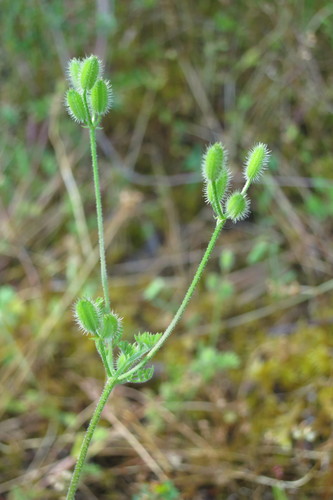
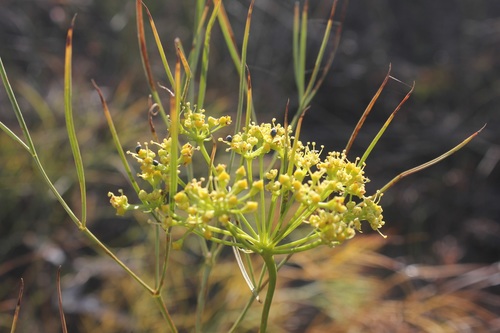
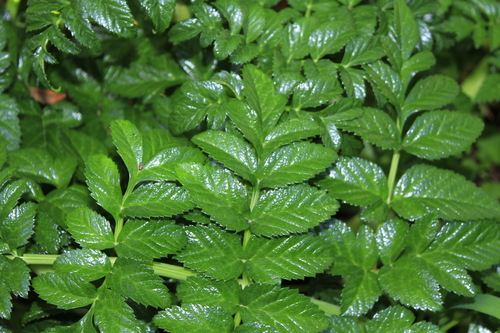
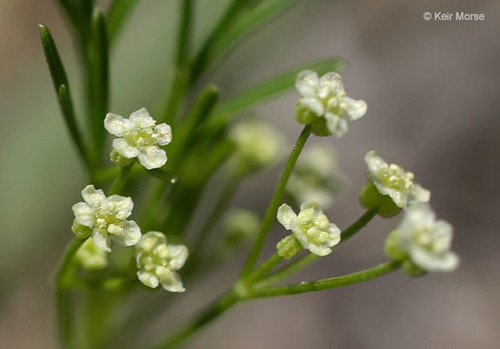
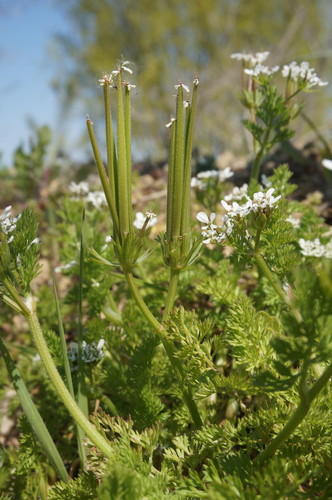
This description applies to Scandix pecten-veneris subspecies pecten-veneris, the only subspecies of this species that occurs in the U.K. It is a sparsely hairy annual plant. Stems grow up to 50 cm and become hollow as they age. Leaves are bi- to tri-pinnate, with narrow lobes around 10 mm long that are entire to pinnatifid. The leaf petiole is broadened at the base, with a scarious margin that is usually ciliate. Umbels have 1 to 3 stout glabrous to sparsely hairy rays that measure 0.5–4 cm in length; the peduncle is very short or entirely absent. Terminal umbels bear hermaphrodite flowers, while lateral umbels bear variable proportions of male and hermaphrodite flowers. Bracts are usually absent; bracteoles are usually 5 in number, longer than the pedicels, and can be simple or irregularly, often deeply, divided. Flowers are white; sepals are small; outer petals are not radiating; styles have an enlarged base that forms a stylopodium. Fruits measure 30 to 70 mm, are more or less cylindrical and slightly compressed laterally, with a strongly dorsally flattened beak that is 3 to 4 times as long as the seed-bearing portion and plainly distinct from it. Fruits are constricted at the commissure; mericarps are ribbed and scabrid, with forward-pointing bristles on their margins. A carpophore is present; vittae are solitary and conspicuous. Pedicels are almost as thick as the rays, and glabrous at the apex; styles are 2 to 4 times as long as the stylopodium, and erect; the stigma is tapering. Cotyledons taper gradually at the base, with no distinct petiole. Flowering occurs from May to June. Scandix pecten-veneris has a range that extends from Western, Central, and Southern Europe eastwards to Western and Central Asia, and it is also found in the Maghreb. In the U.K., this plant was formerly widely distributed as an arable land weed across southeast England, reaching as far west as Wiltshire, but became quite rare in its former sites. This decline was initially attributed to stubble-burning and the use of modern herbicides. However, this narrative of decline was updated in 1996 by wild food enthusiast Richard Mabey. He noted that while the species had suffered a dramatic decline in England starting in the 1950s, it began to recover after stubble-burning was banned in the early 1990s. Contrary to earlier assumptions, the plant is actually resistant to modern herbicides. Mabey also observed that the plant's 'needles' are not easily separated from wheat by modern harvesting machinery, which is another factor contributing to its return to the English countryside. Scandix pecten-veneris is a ruderal species that tends to favour dry, calcareous soils. It often grows in open meadows and woodland edges, and grows well in arable land. It was formerly cultivated as a vegetable, and was also gathered from the wild. As an edible plant, Scandix pecten-veneris has a long history of use across Europe, both as a leaf vegetable and as a salad vegetable. Some of the earliest references to its consumption appear in Ancient Greek texts satirising the tragedian Euripides, who lived c.480–c.406 B.C. on Salamis Island. These texts portray Euripides' mother Cleito as a humble greengrocer who sold the vegetable scandix among her produce; this name was adopted directly into Latin as a name for chervil, a related edible umbellifer. Ancient Greek writers Theophrastus and Erasistratus of Ceos also mention the edible plant scanthrix, and author Pedanius Dioscorides uses the variant name scanthrox for the same plant. Among Latin authors, Pliny the Elder lists scandix among the edible plants of Egypt. Much later, Vicentine physician Onorio Belli, also known as Honorius Bellus, who lived 1550–1604, noted that in his time the plant was eaten on the island of Crete.