About Scalesia pedunculata Hook.fil.
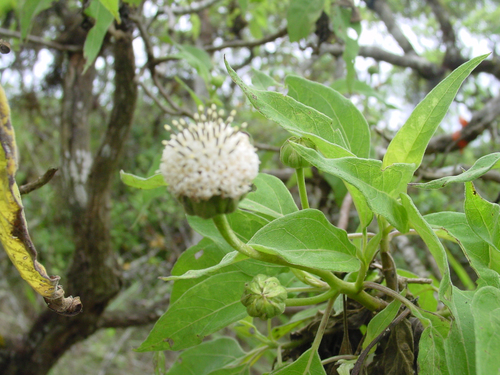
Scalesia pedunculata Hook.fil. is a flowering plant species in the daisy family Asteraceae that grows into a slender tree, reaching up to 20 meters tall with a 20 cm diameter at breast height. It forms dense stands on the humid windward coasts of the Galapagos Islands, specifically on Santa Cruz, San Cristobal, Santiago, and Floreana. The Galapagos archipelago sits in the southeast trade wind zone, so local climate and weather are shaped by moisture-bearing trade winds and island topography; in general, windward sides of the islands receive far higher precipitation than leeward sides. On Santa Cruz, Scalesia pedunculata grows best at altitudes between 400 and 700 meters, a zone that is almost always shrouded in fog, with rain being uncommon. Perennial mists provide moisture for thriving epiphyte communities that grow on the tree trunks and branches; water from these mists eventually trickles down to the ground and soil below. The species is classified as vulnerable. Threats it faces include human encroachment, invasive introduced plant species such as Cedrela odorata and Psidium guajava, and grazing by introduced goats. Fires and cutting for fuel also contribute to population decline, even though the tree’s wood is soft with a large, pithy center. Its inflorescences are capitulae borne on long peduncles, and the capitulae are composed only of disc florets with no ray florets. Charles Darwin first collected specimens of this species from Santiago Island (called 'James Island' at the time) in October 1835 during the voyage of the Beagle. It was later named and described by Joseph Dalton Hooker, Darwin’s friend. Hooker originally described the plant as 'frutescens' (shrubby), because he thought Darwin had made a mistake in recording it as a tree, since members of the daisy family rarely reach such a large size. All 9 formally described species in the genus Scalesia (plus 5 additional unassessed species) are endemic to the Galapagos Islands. Three Scalesia species grow to tree size: Scalesia pedunculata, S. cordata, and S. microcephala, and all three form dense forests. The genus name Scalesia originated from an error by botanist Arnott, who named it to honor "W. Scales Esq., Cawdor Castle, Elginshire". After the genus was published in 1836, Arnott discovered the name was meant to honor 'Stables', referring to Scottish botanist William Alexander Stables (1810 – 21 June 1890). Stables contributed to botanical literature and worked as a factor, or property manager, for John Campbell, 2nd Earl Cawdor. The biology of this species has not been thoroughly studied. Trees take approximately 15 years to reach maturity, and existing woodland stands usually have very few young trees growing under the canopy. Entire Scalesia woodlands collapse when stressed by drought or excessive rain. Shortly after a collapse, new seedlings begin to germinate, which suggests the species follows a natural cycle of forest growth buildup followed by collapse. The first documented collapse of Scalesia pedunculata forest happened between 1935 and 1940, and the cause of this event remains unclear. The next recorded collapse occurred in 1982-1983, which coincided with an El Niño event that brought many weeks of heavy rain. The rain caused the trees’ roots to rot, and subsequent strong winds flattened the entire forest.