About Scaevola chamissoniana Gaudich.
Scaevola chamissoniana Gaudich. is a shrub in the plant family Goodeniaceae. It is native to the Hawaiian Islands, where it is commonly called Mountain naupaka or Naupaka kuahiwi. This species was first formally described in 1829 by Charles Gaudichaud-Beaupré, and its specific epithet chamissoniana honors Adelbert de Chamisso, a naturalist who participated in a king-ordered expedition around the world.
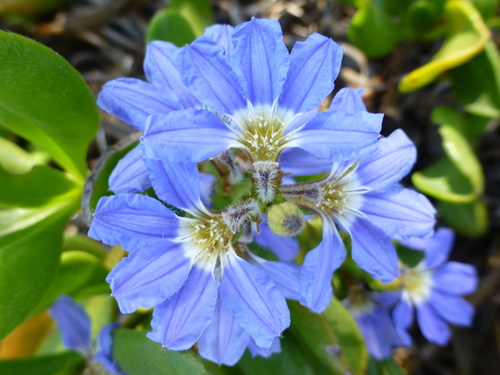
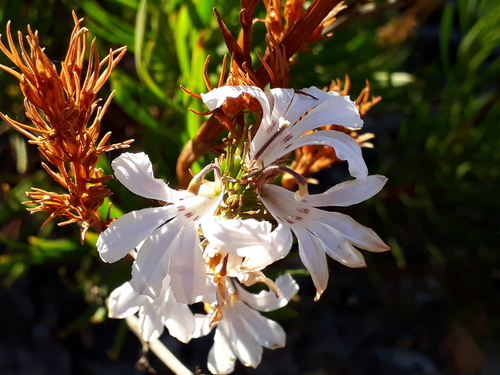
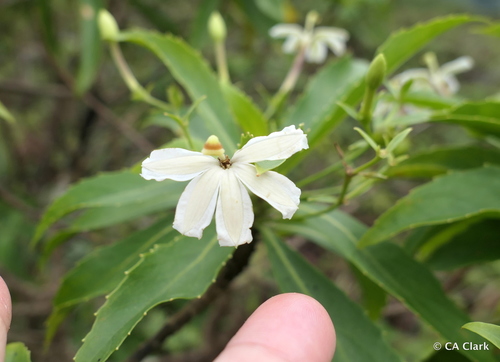
Naupaka plants, including this species, have five-petaled flowers with a single plane of bilateral symmetry, and spiral leaves. They are classified in the subclass Asteridae, and share many characteristics with other fanflower plants. There are eight native Naupaka species in Hawaii, which grow in separate habitats and do not occur in the same locations. Beach naupaka grows only in beach environments, where it is well adapted to sun heat and ocean salt spray, and it produces pure white flowers. Mountain naupaka (Scaevola chamissoniana) requires high elevation, cooler, rainy mountain areas, and its flowers come in different shades of purple and violet. Despite their identical flower structure, beach and mountain naupaka have completely opposite habitat requirements, which makes this group of plants unique.
Scaevola chamissoniana is endemic to the Hawaiian Islands, and occurs most commonly on Kauai and Oahu across all elevations. The original description notes it can be found in wet forests and open areas at around 1150 feet elevation, and it is abundant year-round in tropical forests and open areas. It grows as a dense, large shrub in forest undergrowth, and is well adapted to the moist air and wet environment of the Hawaiian Islands.
Naupaka flowers bloom year-round, and Scaevola chamissoniana’s blooming occurs sporadically throughout the year. Naupaka flowers are primarily pollinated by native Hawaiian bees, which are attracted to the flower’s distinct pistil, shaped by the characteristic half-structure of the flower. Beach naupaka relies on seed dispersal by ocean currents and birds to colonize coastal areas, while mountain naupaka (Scaevola chamissoniana) depends on land-based animals and gravity to spread its seeds within mountain ecosystems. Both forms have adapted their reproductive strategies to their specific environments to ensure long-term survival.