About Scaevola aemula R.Br.
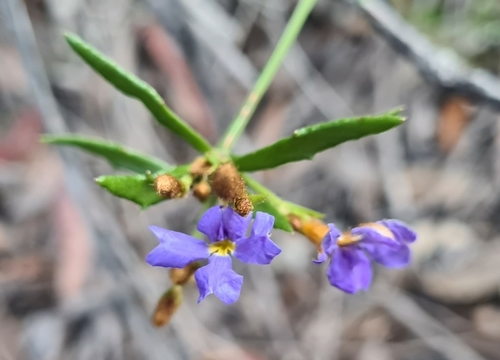
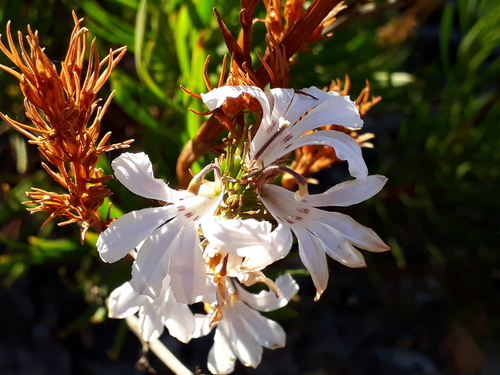
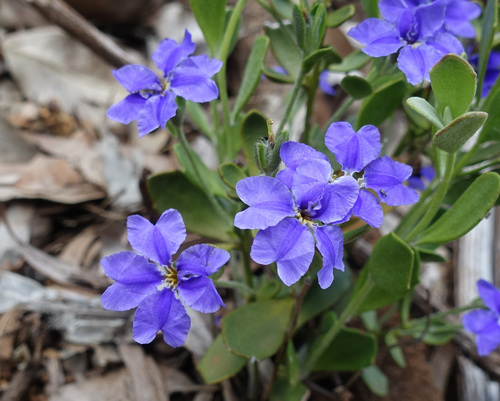
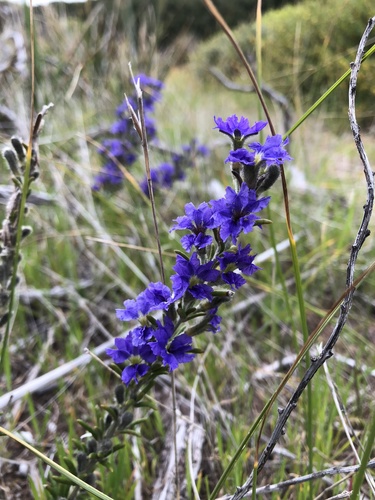
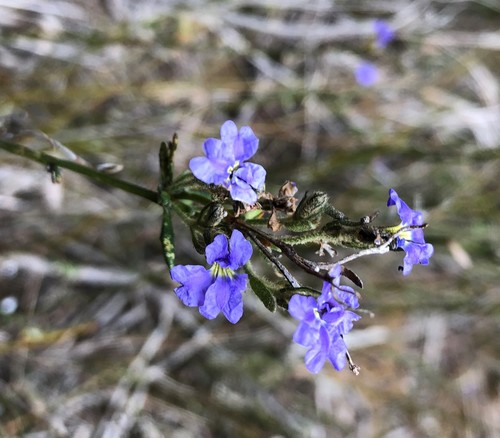
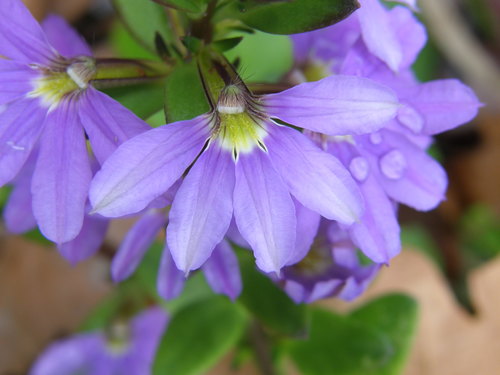
Scaevola aemula R.Br. is a mat-forming perennial herb that reaches a maximum height of 50 cm. It has brown, coarsely hairy, terete stems. Its leaves are elliptic to egg-shaped, tapering toward the base, sessile, with toothed edges. Leaves range from 10 to 88 mm long and 4 to 31 mm wide, and grow smaller in size close to flower clusters. The species produces fan-shaped flowers that are white, blue, or mauve with a yellow center. These flowers grow on spikes up to 24 cm long. The corolla of the flower is 17–25 mm long, has flattened hairs on its outer surface, is bearded on the inside, and has wings 1–1.5 mm wide. Small, leaf-like bracts are present, and lance-shaped bracteoles measure 4.5–7 mm long. Flowering most often occurs between August and October. After flowering, the plant produces rounded, wrinkled drupes up to 4.5 mm long, covered in short soft hairs. This plant, commonly called fairy fan-flower, grows in dry sclerophyll forest, mostly on sandy soils. Its natural range extends from the Eyre Peninsula in South Australia, through Victoria to Mount Warning in New South Wales, and it is also found in the Esperance Plains bioregion of Western Australia. It additionally occurs in Tasmania's Great Oyster Bay region, between the Prosser River and Apsley River. This species is considered the most commonly cultivated member of the genus Scaevola, and many cultivars have been developed for horticultural use. Most cultivated cultivars are mat-forming, reaching 12 cm in height and spreading up to 1 metre wide. It grows best in a sunny or partially shaded location with well-drained soil, and tolerates both salt spray and periods of drought. Tip pruning and pinching can be done to shape the plant. It can be propagated from cuttings or via layering.