About Scadoxus membranaceus (Baker) Friis & Nordal
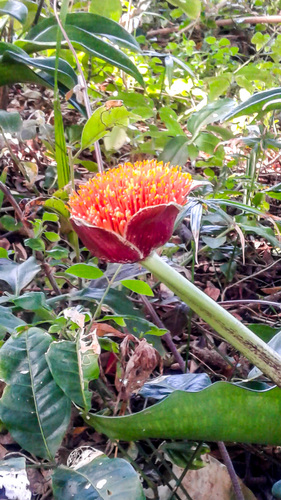
Scadoxus membranaceus is the smallest species in the genus Scadoxus. It grows from a bulb that produces three or four thin leaves. Its leaf stalk (petiole) reaches 3–6 inches (8–15 cm) in length, while the leaf blade measures 4–6 inches (10–15 cm) long. Flowers are held in an umbel roughly 1.5 inches (3.8 cm) across, at the end of a leafless stem called a scape. Typically four bracts lie underneath the umbel, enclosing it to roughly the height of the flower tips. These usually colored bracts remain present through both flowering and fruiting. Individual flowers can be green, pink, or pale red. The tepals are fused at the base, forming a tube that is about one third the total length of the flower. The stamens and style are slightly longer than the flower, so they protrude outward. Ripe berries of this species have been described as "especially showy". This species is native to the east coast of South Africa, ranging from eastern Cape Province in the south to KwaZulu-Natal in the north. It grows in coastal sand, and also grows as a lithophyte on rocks, where enough accumulated material has built up to create an open rooting medium. The genus Scadoxus includes some strongly toxic species that contain poisonous alkaloids. These alkaloids are lethal to grazing animals like sheep and goats that eat the plants. Other Scadoxus species are used as components of arrow poisons and fishing poisons in parts of tropical Africa. Scadoxus membranaceus is not common in cultivation. It can be grown when kept at a minimum temperature of 5 °C (41 °F), such as the conditions provided by a heated greenhouse in less suitable climates. It requires an open growing medium, similar to that used for orchids. It is propagated by seed, and faces the same general pests as other Scadoxus species.