About Sayornis phoebe (Latham, 1790)
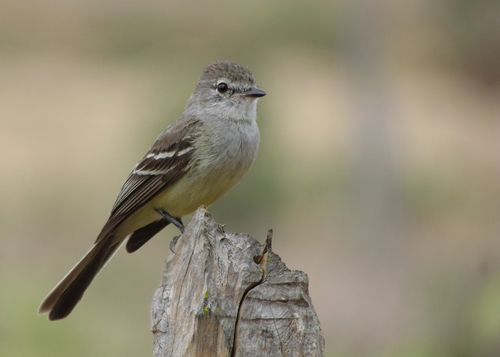
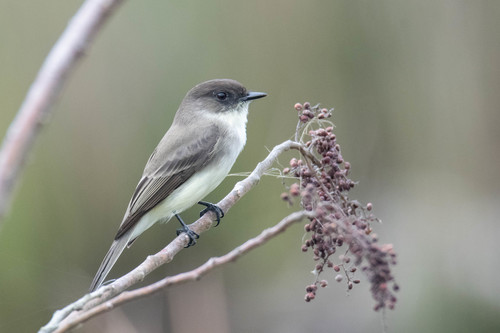
This species, the eastern phoebe, has the following measurements: length 5.5–6.7 in (14–17 cm), weight 0.6–0.7 oz (16–21 g), and wingspan 10.2–11.0 in (26–28 cm). It has a noticeably large head, especially when it puffs up its small crest. Its upper plumage is gray-brown, with a white throat, dull gray breast, and buff-toned underparts that turn whiter during the breeding season. Each wing has two faint buff bars. It can be distinguished from other North American tyrant flycatchers by its lack of an eye ring, distinct wingbars, and its entirely dark bill. Like other phoebes, it pumps its tail up and down when perching on a branch. The eastern phoebe's call is a sharp chip, and its name comes from its song, which sounds like fee-bee.
The eastern wood pewee (Contopus virens) looks extremely similar to the eastern phoebe. Unlike the eastern phoebe, it lacks the buff coloring usually present on the lighter parts of the eastern phoebe's plumage, so it always has clearly defined, contrasting wing bars. It also does not habitually bob its tail, arrives on breeding grounds much later than the eastern phoebe, but departs for wintering grounds at around the same time.
The eastern phoebe often nests on human-made structures such as bridges and buildings. Nesting activity can start as early as the first days of April. It builds an open cup nest with a mud base, lined with moss and grass, placed in a crevice on a rock or a man-made site. Females lay two to six eggs per clutch. Both parents feed the young, and pairs usually raise two broods each year. The eastern phoebe is occasionally used as a host by the nest-parasitic brown-headed cowbird (Molothrus ater).
Eastern phoebes are highly adaptable to urban environments. They are primarily found in wooded areas, especially along streamsides, and in farmlands. They tend to avoid open areas, and select locations under trees, in brushy areas, or under overhangs. During migration, winter, and the breeding season, they are frequently seen along wood edges and other areas with abundant water sources.