About Sayornis nigricans (Swainson, 1827)
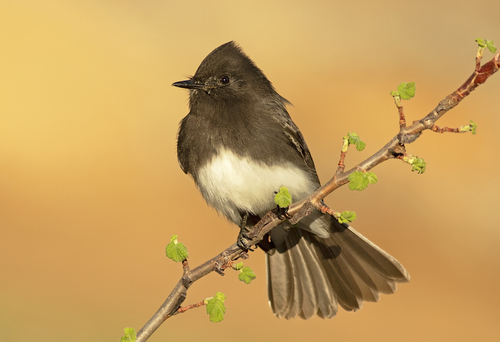
The black phoebe (Sayornis nigricans, first described by Swainson in 1827) is a medium-sized flycatcher. It measures 16 cm (6.3 in) in length and weighs 15 to 22 g (0.5 to 0.8 oz). Its plumage is predominantly black, with white markings on the belly and undertail coverts; this white shape forms an inverted "V" on the lower breast. Adult sexes have identical plumage, and plumage does not change with the seasons. Juvenile black phoebes have browner overall plumage, with cinnamon-brown feather tips across their bodies and brown wing-bars. This species has brown irises, and black legs, feet, and beak. Black phoebes can be identified by their characteristic "tail-wagging" motion, where the tail is lowered and its feathers are fanned out. Almost all of their movement is done by flight, which follows a direct path with steady wing beats. Their song is made of two alternating phrases, transcribed as tee-hee, tee-ho or sisee, sitsew. Both sexes can sing, though songs are more commonly produced by males. The black phoebe breeds across western and southwestern United States, Mexico, Central America, and parts of South America. In Oregon, it occurs in Pacific coast river valleys, and in California it is found on the western side of the Coast Ranges. It breeds throughout the Colorado River valley, and is occasionally found further north in southern Nevada and southwestern Utah, as well as across Arizona and central New Mexico. The breeding range of the black phoebe in the United States extends southeast as far as the Lower Rio Grande Valley. In Central America, it breeds on Baja California (excluding the central part of the peninsula) and on interior mainland Mexico, extending southwest to Panama but excluding El Salvador. In South America, it occurs in the coastal mountains of Venezuela, through Colombia, Ecuador, and Peru, reaching as far south as western Bolivia and northwestern Argentina. Most of the black phoebe's range is occupied year-round, and the species is more sedentary (non-migratory) than the other two phoebes in its genus (Eastern phoebe and Say's phoebe). Northern populations of black phoebe may be partially migratory. The black phoebe is always found near water, and often occurs at coastal cliffs, river or lake banks, and even park fountains. Their breeding habitat must also include a supply of mud for nest building, and this specialized nesting requirement likely explains the species' somewhat irregular distribution range.