About Saxifraga stolonifera Curtis
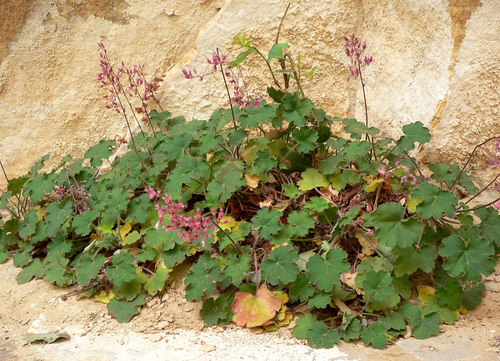
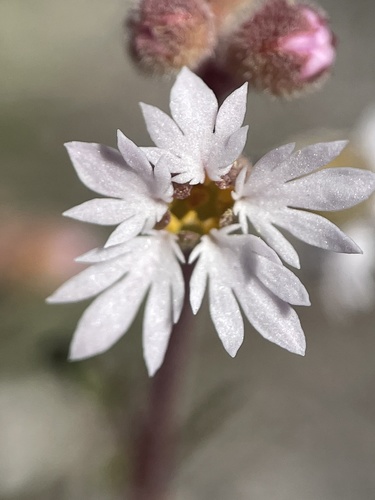
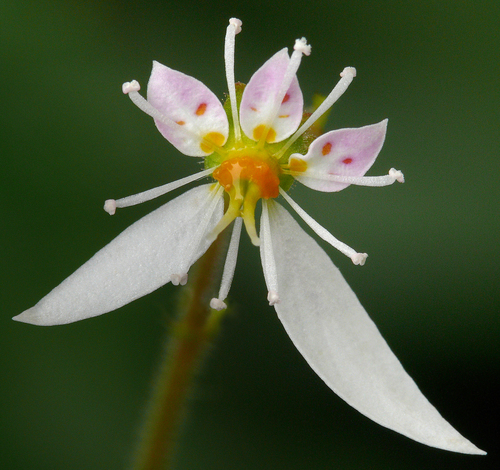
This perennial herbaceous plant, Saxifraga stolonifera Curtis, spreads via threadlike red stolons, also called runners, that produce rooted plantlets near the parent plant. Like strawberry plants, it forms clones at the tips of its stolons, allowing it to spread easily, and develops long thin extensions with scale-shaped leaves. The plant grows 10 to 20 cm tall. It is hardy to USDA zone 5. Its basal leaves have green upper surfaces marked with silver-gray veins and reddish undersides; leaves are rounded in outline, have irregularly serrated margins, and can be trimmed, rounded, or heart-shaped at the base. Leaf petioles measure 15 to 21 cm long. Stem leaves are lanceolate, reaching only 6 mm long and 2 mm wide. Inflorescences bear small zygomorphous flowers that bloom as spring transitions into summer, with a flowering period from May to August. The loose, paniculate inflorescence holds between 7 and 60 flowers. Sepals may be protruding or bent backward. Of the five petals, two are characteristically longer than the remaining three; the longer lanceolate petals are pointed, measuring 6 to 15 mm long and 2 to 4 mm wide, while the smaller petals are dotted red or yellow, and measure 2 to 4 mm long and 1 to 2 mm wide. Stamens are 4.5 mm long, and the ovary is pale yellow. The species is native to China, Japan, and Korea, and is now widespread across most temperate regions of Eurasia and North America. In its native range, it grows successfully in forests, shrubs, meadows, and even on rocks, at altitudes from 400 to 4500 meters. It is now cultivated as an ornamental plant worldwide. In Japanese cuisine, its foliage is occasionally eaten fresh or cooked. It was also used as an herbal remedy in classical Japan. Saxifraga stolonifera contains quercetin, which has demonstrated anti-cancer activity in vitro. A popular garden flower, it has attractive white blossoms with distinctive pointed petals and a bright yellow ovary. It requires a sheltered growing location in full or partial shade. Its creeping green foliage makes it an excellent groundcover, and it is semi-evergreen in favorable growing conditions. It has been awarded the Royal Horticultural Society's Award of Garden Merit.