About Saxifraga paniculata Mill.
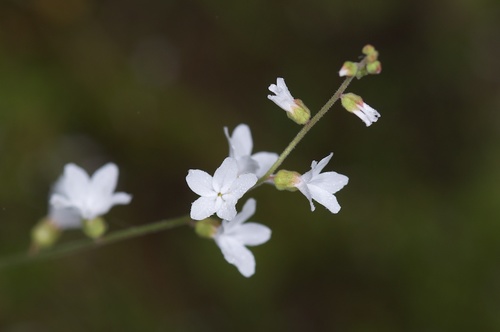
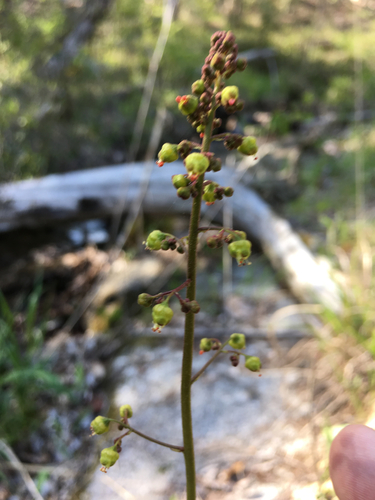
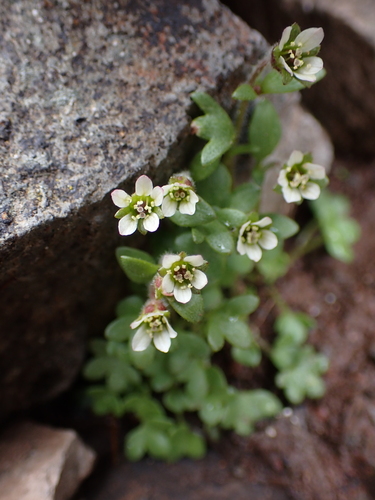
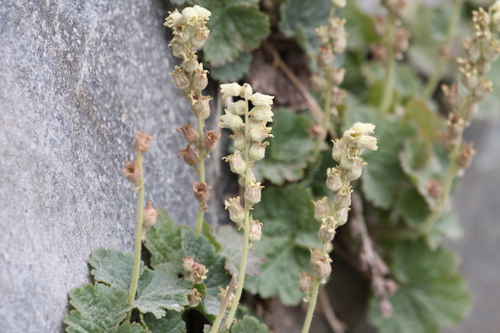
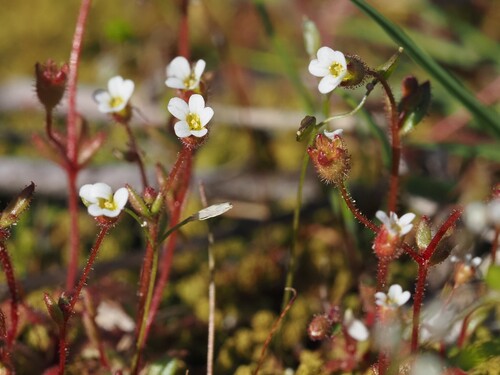
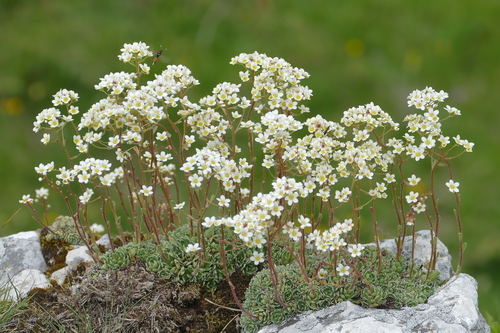
Saxifraga paniculata Mill. is a perennial, stoloniferous herbaceous plant with flowering stems that grow 10–30 cm tall. Its most easily identifiable feature is a very dense basal rosette of leathery, flat, stiff leaves. These oblong to ovate leaves are 1–3 cm long, densely toothed, with fine leaf margins, and a lime-encrusted white pore sits at the base of each leaf. Rosettes grow at the end of long, horizontal stolons (runners), and rosettes produce erect flowering stems, though some rosettes may not produce flowering stems for a few years. Flowering stems bear reduced, scattered leaves, and end in a somewhat elongated cluster of flowers. The flowers are white, roughly 1 cm across, and marked with purplish or red dots. It flowers from mid-to-late June to early August, and produces perfect flowers that have both stamens and carpels. Flowers have five petals, two styles, one inferior ovary, and form a two-beaked seed capsule. Warming noted in 1909 that the flowers are protandrous: they produce and disperse pollen even before their stigmas become receptive. Despite this, the plant is capable of self-pollination. Saxifraga paniculata can sometimes be confused with Saxifraga tricuspidata (prickly saxifrage), a species in the same genus that shares a similar growing range. The two can be distinguished because S. tricuspidata lacks lime-encrusted leaf pores, and has crowded, much narrower leaves that have smooth margins other than three stiff, spine-tipped teeth at their tips. This species grows across the Circumboreal Region. It can be found throughout Central Europe, Greenland, Iceland, Scandinavia, the Caucasus, and North America. In North America, it occurs in the northern Great Lakes region, New England, and New York State. Only historical records exist for its presence in Maine. It is currently present but considered rare in Vermont, Nova Scotia, Newfoundland Island, New Brunswick, Minnesota, and Labrador. Saxifraga paniculata is a calciphile, so it grows in calcareous habitats, most commonly in crevices of basic rocks including basalt and volcanic rock conglomerates. It prefers shady rock crevices or rock ledges. The ability of Saxifraga paniculata to close its leaf rosettes during harmful environmental conditions such as extreme heat and drought gives it very high resistance to sustained photoinhibition and irreversible dehydration. A 2006 paper by Hacker and Neuner found that this species is more resistant to cold-induced winter photoinhibition than any other evergreen subalpine species the research group studied. Due to the short growing season and potential lack of pollinators, S. paniculata (like many arctic plants) can self-pollinate. While self-pollination is usually avoided by plant species because it does not produce offspring with genetic variation, it ensures the plant can still produce and disperse seed when conditions are difficult. In the wild, Saxifraga paniculata has been observed growing alongside many associated species, including but not limited to Trisetum spicatum, Polygonum viviparum, Polypodium virginianum, Sagina nodosa, Woodsia alpina, Campanula rotundifolia, Rubus pubescens, Aralia nudicaulis, Tortella tortuosa, Aquilegia canadensis, Carex eburnea, and Woodsia glabella, as well as lichen. Saxifraga paniculata is cultivated as an ornamental garden plant. It is hardy, but dislikes winter wetness and requires very sharp drainage in alkaline or neutral soil. For this reason, it is most often grown in rock gardens or alpine houses. It has given rise to many hybrids and cultivars, and three of these have earned the Royal Horticultural Society's Award of Garden Merit: 'Lavagreana', 'Rosea', and 'Venetia'.