About Saxifraga flagellaris Sternb. & Willd.
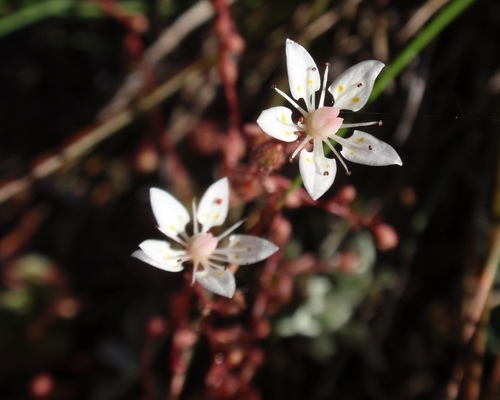
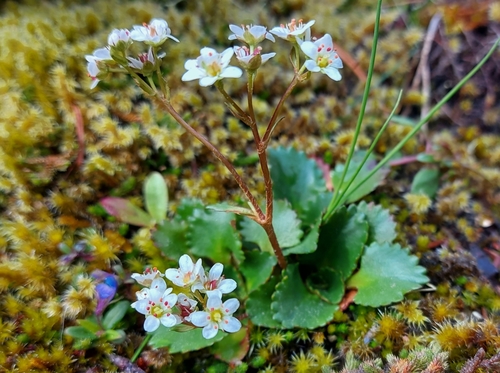
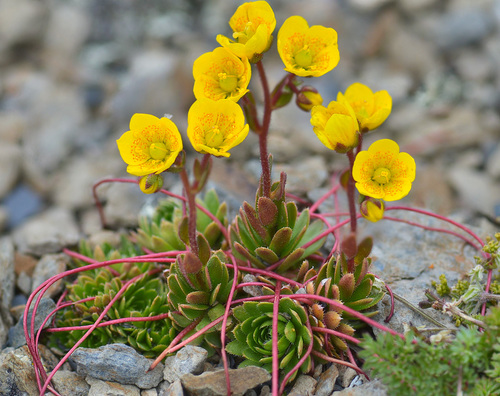
Saxifraga flagellaris, common names whiplash saxifrage or flagellate saxifrage, is an uncommon plant native to the entire Eurasian Arctic Coast, Siberia, the Far East, the Caucasus, and some areas of the northern Rocky Mountains. It is also called spider saxifrage or "spider plant", though the name "spider plant" most commonly refers to the unrelated Chlorophytum comosum, a member of Agavaceae. Broadsepal saxifrage, formerly S. platysepala, was first included in this species, then split as a separate species, and later reclassified as the subspecies Saxifraga flagellaris ssp. platysepala, or broadsepal saxifrage. Populations found in Greenland, Svalbard, Alaska and similar regions belong to this subspecies. This species produces single, erect, leafy stems that grow 3–10 cm tall. Basal leaves form a dense rosette, from which long, filiform runners radiate out; these runners end in a small, rooting offset, and the leaf margins have glandular hairs. Each stem usually bears one terminal flower, rarely two, with golden yellow petals that are much longer than the calyx lobes. The whole plant is more or less red in color. It grows in moist places, on gravel, or in moss carpets. It is not at any risk of extinction, but is nonetheless very rare. Saxifraga flagellaris was described by Willdenow, and other authors often applied this name to Saxifraga platysepala, or broadsepal saxifrage.