About Saxifraga aspera L.
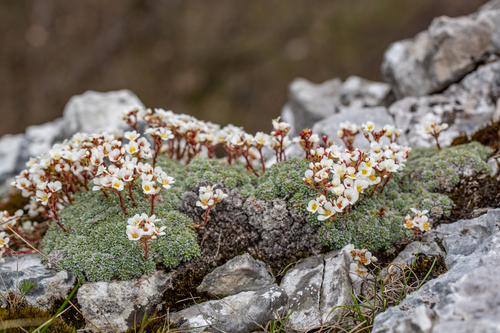
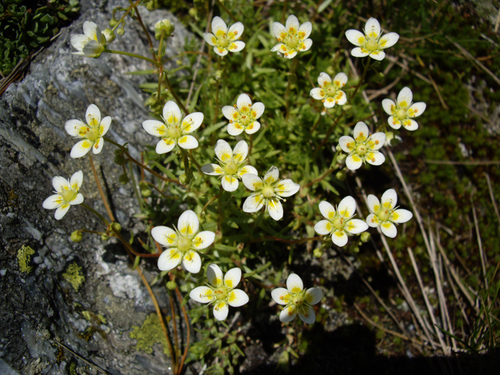
Rough saxifrage, Saxifraga aspera L., is a perennial herb that forms short, tufted basal rosettes, growing in small loose clumps to around 5 centimetres (2.0 inches) tall. Its linear lanceolate leaves have margins fringed with short bristly hairs, which give the plant its characteristic rough appearance. The foliaceous buds that grow in leaf axils are only half as long as the leaves that protect them; this trait distinguishes this species from the similar mossy saxifrage, Saxifraga bryoides. Flowers reach up to 2 centimetres (0.8 inches) in diameter, and are borne singly or in few-flowered spikes on long, erect stems that bear a small number of small leaves. Each flower has five calyx lobes and five broad, slightly overlapping white or cream-coloured petals, with a yellow blotch near the base and sometimes additional yellow spots. The ten stamens are arranged in two whorls, with one whorl slightly longer than the other. The ovary is superior, and the fruit produced is a two-celled capsule. Rough saxifrage blooms in June and July. Rough saxifrage is predominantly a plant of Arctic tundra. It is one of only two species in Saxifraga section Trachyphyllum, the other being Saxifraga bryoides, that extends its range into Western Europe. In Western Europe, it grows at altitudes between 1,400 and 3,000 metres (4,600 and 9,800 ft) in the Alps, Pyrenees, and northern Apennines. It typically grows on damp rocks and gravel along stream banks, though it can sometimes be found growing in turf. It prefers acidic conditions and does not grow in calcareous soils.