About Saxicola rubetra (Linnaeus, 1758)
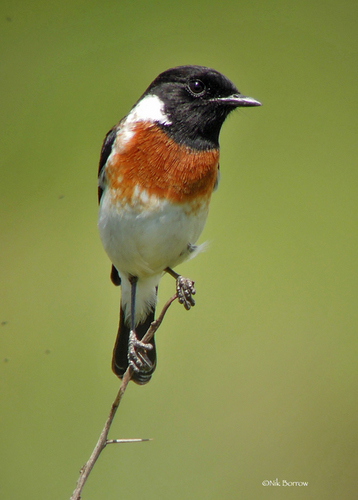
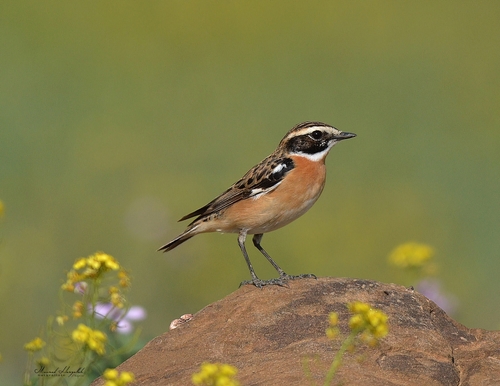
Saxicola rubetra, commonly called the whinchat, is a short-tailed bird that moves across the ground in small rapid hops, and frequently bobs and flicks its wings and tail. It is similar in size to the European robin (Erithacus rubecula), with a body length of 12 to 14 cm (4.7 to 5.5 in) and a weight of 13 to 26 g (0.46 to 0.92 oz). Both sexes share common plumage traits: brownish darker-mottled upperparts, a buff throat and breast, a pale buff to whitish belly, and a blackish tail with white bases on the outer tail feathers. Breeding-plumage males have a blackish face mask almost fully encircled by a prominent white supercilium and malar stripe, bright orange-buff throat and breast, and small white wing patches on the greater coverts and inner median coverts. Females are duller overall: they have a browner face mask, a pale buffy-brown breast, buff supercilium and malar stripe, and smaller or absent white wing patches. Immature and winter-plumage males resemble females, though adult males keep their white wing patches year-round. Whinchats are fairly similar to female and immature European stonechats (S. rubicola), but can be easily distinguished by their conspicuous supercilium, whiter belly, and in western Europe, a paler overall plumage compared to the western European stonechat subspecies S. rubicola hibernans. Structurally, whinchats are slightly slimmer, less stocky, and have longer wingtips, an adaptation for their long-distance migration. They are more easily confused with female or immature Siberian stonechats (S. maura), which are also long-distance migrants and share longer wingtips. However, Siberian stonechats can be told apart by their conspicuous unmarked pale orange-buff rump; in whinchats, the rump is the same mottled brown color as the back. The whinchat’s main call is described as hue-tac-tac, where the ‘tac’ is softer and less grating than the equivalent call of the European stonechat. This call is used both for contact between birds and as a predator alarm. During the breeding season, males produce a whistling, crackly but soft song made of a mix of soft whistles, tacs, and more grating sounds. The song is often mimetic, incorporating phrases from the songs of at least 12 other assorted bird species. Males sing from a fence, bush, tree or wire, and occasionally from the ground or in flight, between approximately April and July. On wintering grounds, whinchats often give alarm calls but only sing occasionally, most often at the end of winter when they begin spring migration. The whinchat is a migratory species that breeds across Europe and western Asia, ranging from Ireland and northern Portugal east to the Ob River basin near Novosibirsk, and from northern Norway south to central Spain, central Italy, northern Greece, and the Caucasus Mountains. Whinchats arrive on their breeding grounds between the end of April and mid-May, and depart between mid-August and mid-September, with occasional birds lingering into October. They primarily winter in tropical sub-Saharan Africa, from Senegal east to Kenya and south to Zambia. They arrive in western Africa at the start of the dry season, between late September and November, and leave between February and March. Small numbers also winter in northwestern Africa, in Morocco, northern Algeria and Tunisia. Available stopover sites are important for successful whinchat migration between Africa and Europe, where they face the barriers of the Sahara and Mediterranean Sea. Vagrants have been recorded northwest of the breeding range in Iceland, west along migration routes at the Canary Islands and Cape Verde, and south of the regular wintering range in northern South Africa. During the breeding season in the UK, whinchats favour landscapes with high plant species richness and steeper slopes at the broad scale. At the territory scale, they prefer low-elevation areas with a heterogeneous vegetation structure and high density of perches and tussocks. Whinchats wintering in Nigeria come from a large breeding range spread across continental Europe, indicating low population connectivity from wide migratory dispersal and high mixing of breeding populations during the non-breeding season. A lone vagrant was sighted for the first time in India by birder R. Mohammed Saleem during the Great Indian Bird Expedition SEEK2019 at Chambal National Park. The whinchat is a largely solitary bird, though it may form small family groups in autumn. It favours habitats with rough low vegetation, such as open rough pasture or similar minimally cultivated grassland with scattered small shrubs like hawthorn (Crataegus monogyna), and bracken (Pteridium aquilinum) or heather (Calluna vulgaris) stands on rock-strewn ground. It also commonly lives in new and clear-felled conifer plantations, until the new tree crop is about five to six years old and one or two meters tall. It always requires at least a few perching points (shrubs, tall weeds, or fence posts) to scan for food and use as song posts. Breeding occurs in late April and May. Only the female builds the nest, which is constructed from dried grasses and moss, and lined with hairs and fine bents. The nest is built on the ground, hidden in dense low vegetation, often at the foot of a bush. The female lays and incubates a clutch of four to seven eggs, which hatch after eleven to fourteen days. Both parents bring food to the young, which leave the nest ten to fourteen days after hatching while they are still too young to fly. The chicks fledge at seventeen to nineteen days after hatching and remain largely dependent on their parents for a further two weeks. Whinchats are short-lived, with a typical survival of just two years, and a maximum recorded lifespan of just over five years in the wild. Breeding begins when birds are one year old. Predators of whinchats include weasels, stoats, and small raptors such as the merlin; nest predators include crows and magpies. Nests are also lost to agricultural operations such as silage cutting, which is the main factor driving the species’ decline in western Europe, or trampling by livestock. Nests are sometimes parasitised by the common cuckoo. Whinchats are insectivorous, with approximately 80–90% of their diet consisting of insects, but they also consume a wide range of other invertebrates including spiders, small snails and worms. They also eat small amounts of fruit such as blackberries, primarily in autumn. These birds like to perch on elevated spots such as shrubs, from where they make short flights to catch insects, mostly taken off the ground but also including flying insects. While perched, males in particular frequently flick their tail and sometimes their wings to show white tail and wing flashes, as display or territorial communication signals to other whinchats. Adult whinchats undergo a single complex complete moult in late summer, starting in late July after breeding, which is mainly completed before southbound migration. Juveniles have a partial moult at the same time, growing new body feathers but retaining their flight feathers. All ages also have a partial moult in early spring on the wintering grounds before northbound migration.