About Saxicola dacotiae (Meade-Waldo, 1889)
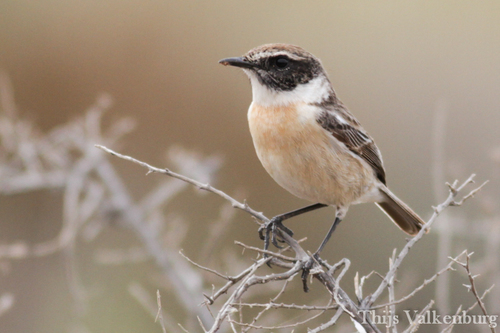
The Canary Islands stonechat (Saxicola dacotiae (Meade-Waldo, 1889)) has an appearance intermediate between the European stonechat and the whinchat, with a body size and shape that resembles a lithe European robin. Its upperparts are generally colored similarly to the whinchat, but with more contrast: dark brown with blackish streaks on the head and back. It has a cleaner white supercilium that extends behind the eye, white sides of the neck, and a light orangey-chestnut breast that becomes duller and paler on the underparts, fading to a whitish belly. Both the rump and tail are dark; the tail has a white pattern that is visible when the bird is in flight, and there is also a white wing band. Females are similar to a faded version of males, with a brown, black-streaked head and no white neck patches. Males produce a ticking call that sounds like one pebble striking another, and a high twittering song similar to that of the European stonechat. This species is highly faithful to preferred good habitat. Its main range and only breeding habitat consists of barrancos, ravines, and rocky slopes with fairly sparse shrubby vegetation (30-50% open ground), per Illera et al., 2006. While individuals sometimes do venture into more open, arid areas such as malpaís (old lava flows with regrowing vegetation), the species prefers copses of palm trees and shrubs (Álamo Tavío 1975) such as aulaga Launaea arborescens, saltwort Caroxylon vermiculatum, and boxthorn Lycium intricatum (BirdLife International 2004). Males sing from exposed perches; birds also hunt insects on the wing from these perches, and will occasionally enter fields or gardens to feed. Completely open habitat is only used when gathering food for their young (BirdLife International 2004). This species lays 4-5 eggs per clutch, incubates for 13 days, and usually successfully raises two clutches of young each year.