About Saururus cernuus L.
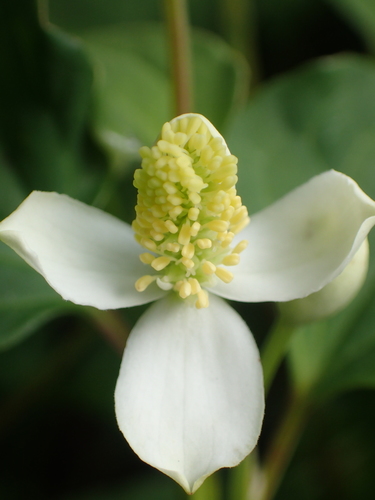
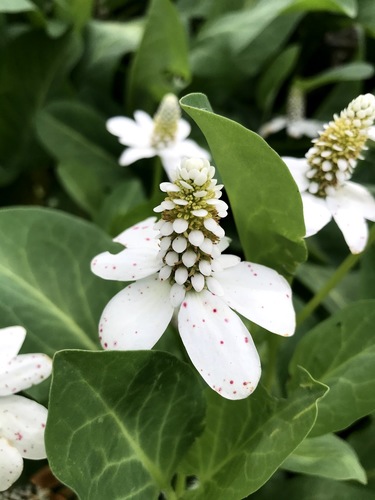
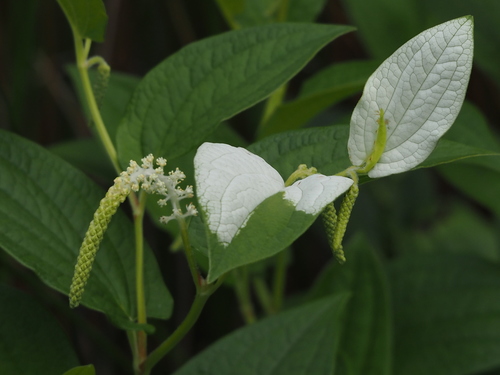
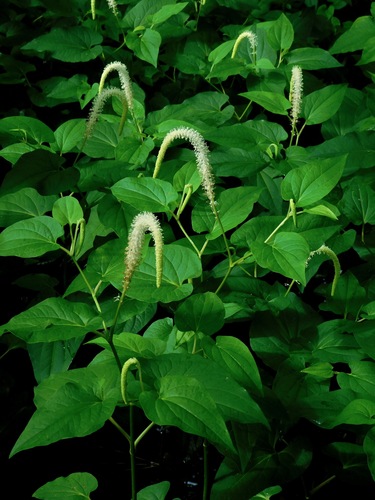
Saururus cernuus (commonly called lizard's tail) is a herbaceous wetland plant that typically grows 0.6 to 0.9 metres (2 to 3 ft) tall. It forms dense rhizomes that allow it to compete very effectively for underground resources. Individual rhizomes can spread laterally through soil up to 3 m (10 ft) long, and feature a linear series of nodes along the rhizome tip. The plant's leaves are alternate along the stem, and can be heart-shaped (cordate), arrow-shaped, or lance-shaped. Crushed leaves release an aroma similar to citrus or sassafras. The plant is easiest to identify during its summer flowering season, which runs from May to early August. It produces small white flowers arranged in a spike inflorescence that measures 7+1⁄2–20+1⁄2 centimetres (3–8 in) long. The flowers are simple, with 6 or fewer stamens and 3 or fewer carpels. Once mature, the flower spikes turn brown, which gives the species its common name of lizard's tail. Seeds ripen and disperse in autumn; they are light green when young and turn brown as they mature. This species is distributed in Ontario, Canada, and across the eastern and southeastern United States, ranging from mid-Atlantic states south to Florida. It grows in freshwater wetlands, most commonly in marshes, along the edges of streams or lakes, and is often found submerged in shallow water. It can grow well in saturated soil and tolerates shade from larger trees. Ecological studies have observed an association between Saururus cernuus and longhorn beetles. Mating of three longhorn beetle species — Strangalia luteicornis, Typocerus lugubris, and Typocerus velutinus velutinus — has been recorded on this plant, and 29 additional beetle species have also been observed on S. cernuus. The plant's flowers and fruits likely act as a food source for many of these beetles. North American beavers (Castor canadensis) strongly prefer lizard's tail over other local aquatic plants, and have a major impact on S. cernuus populations. S. cernuus is far less common in areas with beaver activity; one exclusion study found beavers reduce the plant's prevalence by 45%. If livestock eat large amounts of S. cernuus, it can be toxic to them. Saururus cernuus is used in wetland creation and restoration projects, and native plant nurseries sell its rhizomes for this purpose. Native American peoples and early European settlers used the plant for traditional medicine. Ground rhizomes were used as a sedative, to treat swelling and inflammation, and to reduce fevers. The Cherokee and Choctaw peoples mashed the roots into a poultice to soothe inflammation of the breasts and back. The Seminole used the plant as an antirheumatic, and to relieve fevers and body aches.