About Saucerottia tobaci (J.F.Gmelin, 1788)
Taxonomy and Naming
The copper-rumped hummingbird (scientific name Saucerottia tobaci, originally described by J.F.Gmelin in 1788) is 9 to 11 cm (3.5 to 4.3 in) long.
Size
Males weigh 4.6 to 4.7 g (0.16 to 0.17 oz), while females weigh 3.5 to 4.2 g (0.12 to 0.15 oz). The nominate subspecies S. t. tobaci is the largest of the species' subspecies.
Bill Structure
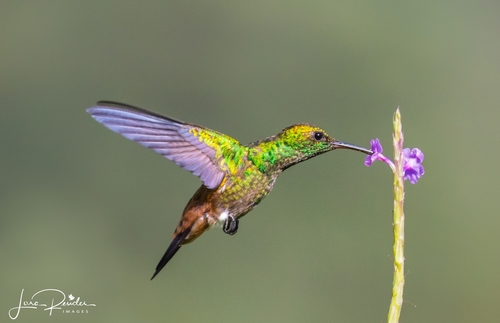
Both sexes of all subspecies share a straight, medium-length blackish bill with a pinkish base on the mandible.
Nominate Male Plumage
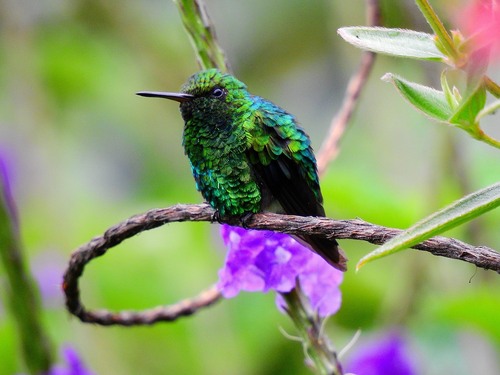
Males of the nominate S. t. tobaci have bronze-green upperparts and purple-red uppertail coverts. Their underparts are dark golden-green, with reddish brown undertail coverts, and their tail is purplish black.
Adult Female Plumage
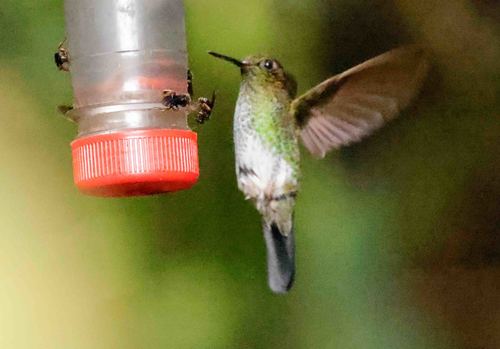
Adult females are similar to males, but their upperparts are a less intense bronze-green, and they have some whitish coloring on the chin and upper throat.
Juvenile Plumage
Juveniles resemble adult females, but have some grayish brown coloring on the throat and belly.
Subspecies Physical Traits
Each of the other recognized subspecies has distinct physical traits: S. t. monticola is darker than the nominate and has a steel blue to violet-blue tail; S. t. feliciae has a more golden-green back than the nominate and a bluish black tail; S. t. caudata has a dark blue tail; S. t. aliciae has copper tones in its upperparts, a blue-black tail, and cinnamon-rufous undertail coverts; S. t. erythronotos has slightly darker underparts than the nominate and some dark purplish coloring in the uppertail coverts; S. t. caurensis has a grayer rump and grayer uppertail coverts than the nominate, a dark purplish tail, and bluish black undertail coverments.
Subspecies Distribution
Each subspecies occupies a distinct range in northern South America: S. t. monticola is found in the northwestern Venezuelan states of Falcón, Lara, and Yaracuy; S. t. feliciae occurs in north and central Venezuela between Carabobo and Anzoátegui, extending south to Táchira, Apure, and Guárico; S. t. caudata is located in the northeastern Venezuelan states of Sucre and Monagas; S. t. aliciae lives on Margarita Island off the coast of Venezuela; S. t. erythronotos is found on Trinidad; S. t. tobaci is native to Tobago; S. t. caurensis occurs in Bolívar and Amazonas states in southeastern Venezuela.
Range Doubt
Specimens of this species labeled as collected from Grenada are believed to have actually been collected on Tobago, so the occurrence of the species in the Lesser Antilles is considered doubtful.
Habitat Types
The copper-rumped hummingbird inhabits a wide variety of forest types, including gallery forest, cloudforest, rainforest, and secondary forest. The two island subspecies S. t. erythronotos and S. t. tobaci are also found in savanna, plantations, and gardens.
Elevation Range
Most subspecies range in elevation from sea level to 1,000 m (3,300 ft). S. t. monticola and S. t. feliciae can be found as high as 2,000 m (6,600 ft), while S. t. aliciae is seldom found at low elevation.