About Satyrus actaea Esper, 1781
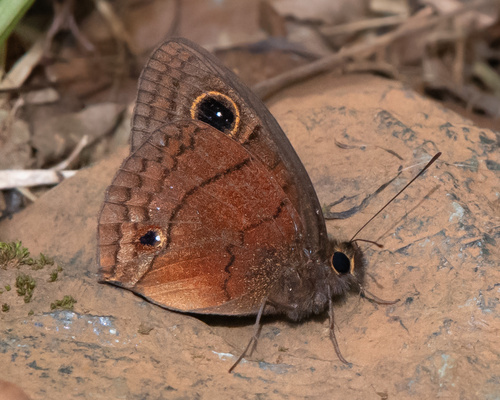
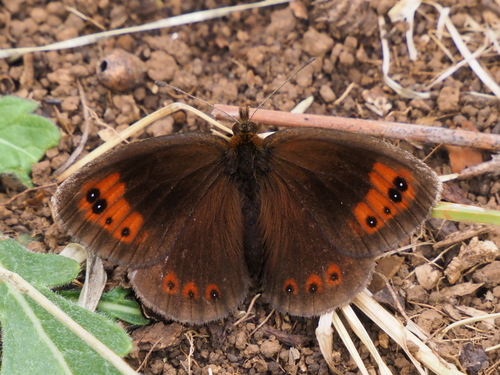
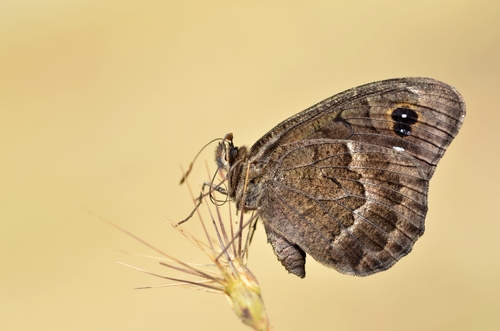
Satyrus actaea, commonly known as the black satyr, is a butterfly species belonging to the family Nymphalidae. It can be found in South-Western Europe, Asia Minor, Syria, Iran, and Baluchistan, which is in southwestern Pakistan. The forewings of this butterfly measure 24 to 28 mm in length. On the upperside, males are black-brown, with a dark sheen on living specimens. The two ocelli on the forewing are usually only marked by small bluish white pupils. In older specimens where the ground color has faded, the pupil is outlined with deep black. Two tiny white dots sometimes appear between the forewing ocelli. As is the case for all Satyrus species, the number of ocelli can be either increased or decreased, as seen in the forms merula Schultz and ornata Schultz. In females, the distal band is marked by a paler, sometimes yellowish brown tint, and the ocelli are noticeably larger than those of males. The underside differs between various forms, featuring a clearly defined distal band, a dark dentate line within the forewing cell and across the hindwing, and a somewhat irregular submarginal line. This butterfly produces one generation per year and is active as an adult during July and August. Its habitat consists of rocky areas at elevations between 600 and 1,800 m. The larvae feed on various grasses including Brachypodium species and Bromus species, as well as sedges.