About Satrapa icterophrys (Vieillot, 1818)
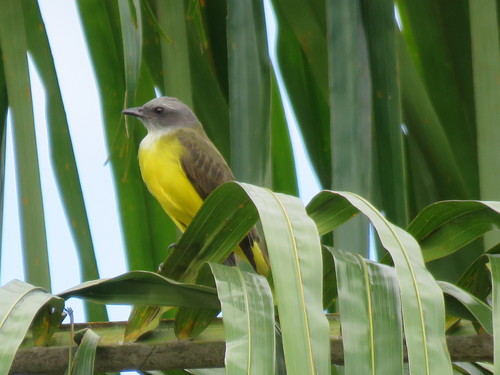
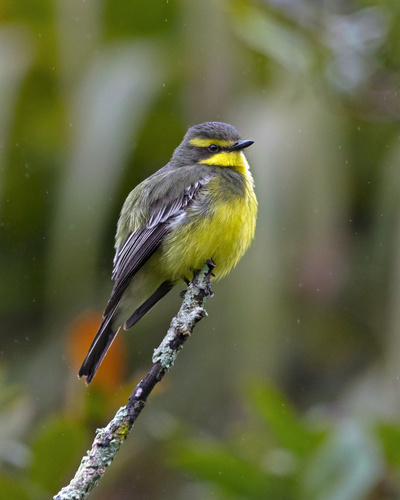
The yellow-browed tyrant, Satrapa icterophrys (Vieillot, 1818), measures 15 to 16.5 cm (5.9 to 6.5 in) in length and weighs approximately 20 g (0.71 oz). Adult males have a mostly dark grayish olive face, marked by a prominent bright yellow supercilium. Their upperparts are dark olive, their wings are dusky black with grayish white edges on flight feathers and grayish white tips on coverts that form two distinct wing bars. Their tail is dusky, with white outer webs on the outermost feathers. Their underparts are bright yellow, with an olive wash on the sides of the breast. Adult females are overall paler than males, particularly in their supercilium and throat, and their throat and breast have olive mottling. Both sexes have a dark iris, a short, narrow black bill, and blackish legs and feet. Juveniles are similar in appearance to adult females, and have olive spots on the breast.
The yellow-browed tyrant has a disjunct distribution. One population occurs across north-central Venezuela, extending a very short distance into eastern Colombia. The second, much larger population ranges from far southeastern Peru across northern Bolivia and central Brazil to the Atlantic coast, stopping short of the far eastern region. This range continues south through southern Brazil, eastern Bolivia, Paraguay, Uruguay, and northern Argentina to reach northern Buenos Aires Province. This species inhabits forest edges, brushy fields, pastures with scattered trees, gallery forest, and wooded areas surrounding lakes and marshes. Its elevation range varies by region: from sea level to 2,000 m (6,600 ft) in Brazil; up to 200 m (700 ft) in Colombia; up to 1,000 m (3,300 ft) occasionally in Peru; up to 500 m (1,600 ft) north of the Orinoco River and only 150 m (500 ft) south of the river in Venezuela; and up to 2,800 m (9,200 ft) in Bolivia.