About Sassafras albidum (Nutt.) Nees
Sassafras albidum (Nutt.) Nees is a medium-sized deciduous tree. It reaches 15–20 m (49–66 ft) in height, with a canopy up to 12 m (39 ft) wide, a trunk up to 60 cm (24 in) in diameter, and a crown made of many slender sympodial branches. Mature tree trunk bark is thick, dark red-brown, and deeply furrowed. Its cotyledons are thick and fleshy. New shoots start bright yellow green with mucilaginous bark, turn reddish brown, and develop shallow fissures after two to three years. The roots are thick and fleshy, and frequently produce root sprouts that grow into new trees.
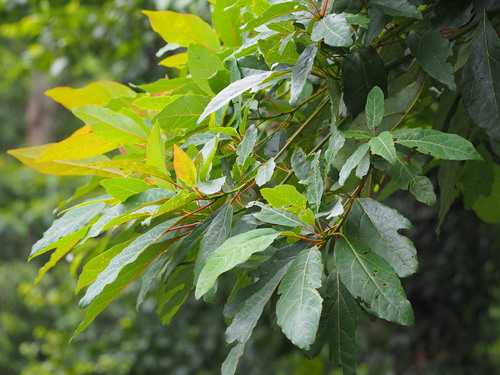
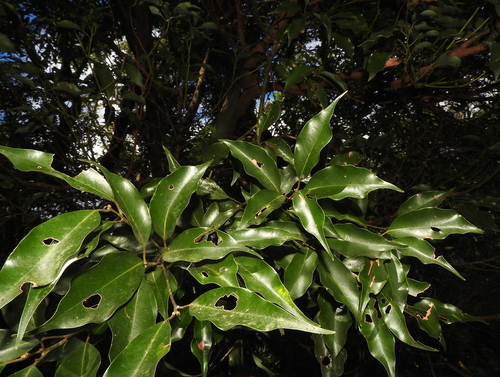
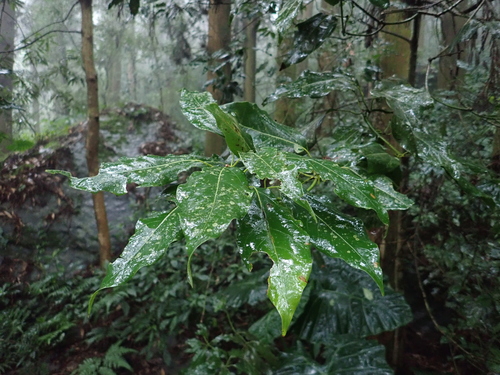
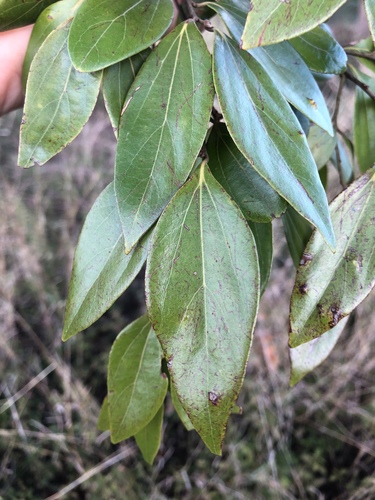
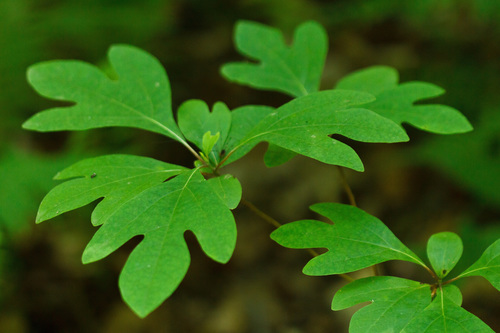
Leaves are alternate, green to yellow-green, ovate or obovate, 10–15 cm (4–6 in) long and 5–10 cm (2–4 in) broad, attached to a short, slender, slightly grooved petiole. Leaves grow in three distinct shapes, all of which can appear on the same branch: unlobed elliptical, two-lobed, and three-lobed; leaves with more than three lobes occur rarely. In autumn, leaves turn shades of yellow tinged with red.
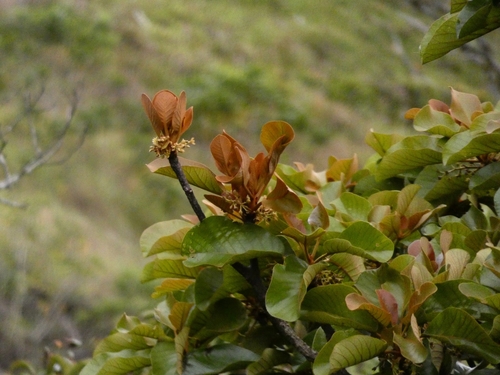
Flowers grow in loose, drooping, few-flowered racemes up to 5 cm (2 in) long, emerging in early spring just before leaves appear. Flowers are yellow to greenish-yellow, with five or six tepals. This species is usually dioecious, meaning male and female flowers grow on separate trees. Male flowers have nine stamens, while female flowers have six staminodes (aborted stamens) and a 2–3 mm style on a superior ovary. Insects carry out pollination.
The fruit is a dark blue-black drupe 1 cm (0.39 in) long containing a single seed. It is borne on a red fleshy club-shaped pedicel 2 cm (0.79 in) long, ripens in late summer, and birds disperse its seeds. All parts of this plant are aromatic and spicy.
This species is native to eastern North America, ranging from southern Maine and southern Ontario west to Iowa, and south to central Florida and eastern Texas. It grows throughout the eastern deciduous forest habitat at altitudes up to 1,500 m (4,900 ft) above sea level. It formerly grew in southern Wisconsin, but is now extirpated there as a native tree.
Sassafras albidum prefers rich, well-drained sandy loam with a pH of 6–7, but will grow in any loose, moist soil. Seedlings tolerate shade, but saplings and older trees require full sunlight for healthy growth; in forests, it typically regenerates in gaps left by windblown trees. Growth is rapid, especially for root sprouts, which can reach 1.2 m (4 ft) in the first year and 4.5 m (15 ft) in four years. Root sprouts often form dense thickets, and a single unrestrained tree will quickly develop a large clonal colony around it as its roots spread outward and produce numerous new shoots. S. albidum is a host plant for the caterpillars of 37 species of butterflies and moths, including the eastern tiger swallowtail (Papilio glaucus), spicebush swallowtail (Papilio troilus), palamedes swallowtail (Papilio palamedes), pale swallowtail (Papilio eurymedon) butterflies, and the cecropia (Hyalophora cecropia), promethea (Callosamia promethea), polyphemus (Antheraea polyphemus), imperial (Eacles imperialis), and io (Automeris io) moths.
All parts of S. albidum—stems, leaves, bark, wood, roots, fruit, and flowers—have been used by humans. Though native to North America, it holds significance in the economic, medical, and cultural history of both Europe and North America. In North America, it has particular culinary importance, appearing in distinct traditional foods including traditional root beer, filé powder, and Louisiana Cajun cuisine.
Before European arrival, it was an important plant for many Native American peoples of the southeastern United States, who used it for both culinary and medicinal purposes, and introduced it to European settlers alongside other plants such as cranberries, tobacco, and American ginseng. The wood is dull orange brown, hard, and durable when in contact with soil. Historically, it was used for posts and rails, small boats, and ox-yokes, though its current use is limited by scarcity and the small maximum size of the tree. Some S. albidum wood is still used to make furniture.
Prior to European colonization, Sassafras albidum was widely used by Native Americans in what is now the Southeastern U.S. The Choctaw name for sassafras is "Kvfi", and the Choctaw used it primarily as a soup thickener. It was called "Winauk" in Delaware and Virginia, and "Pauame" by the Timuca. Some Native American groups rubbed sassafras leaves directly onto wounds to treat them, and used different parts of the plant for a range of medicinal purposes including treating acne, urinary disorders, and fevers. They also used the bark to make dye and as a flavoring. Southeastern Native Americans used sassafras wood as a fire starter because the natural oils it contains are highly flammable. In cooking, some Native Americans used sassafras to flavor bear fat and cure meats. Sassafras is still used to cure meats today. The Choctaw use of filé powder (made from dried ground sassafras leaves) in cooking is linked to the development of gumbo, the signature dish of Louisiana Creole cuisine.
The plant's significance to Native Americans grew after European contact: colonies in Florida, Virginia, and parts of the Northeast established sassafras as an export commodity during the 16th and 17th centuries.
In modern times, Sassafras albidum is used primarily in the U.S. as the key ingredient in home-brewed root beer, and as a thickener and flavoring in traditional Louisiana Creole gumbo. Filé powder, also called gumbo filé, is a spicy herb made from dried and ground sassafras leaves. It was traditionally used by Native Americans in the Southern U.S., and was later adopted into Louisiana Creole cuisine. The leaves and root bark can be pulverized to flavor soup, gravy, and meat. Sassafras roots are used to make traditional root beer, but the U.S. Food and Drug Administration banned sassafras for use in commercially mass-produced foods and drugs in 1960. Laboratory animals given oral doses of sassafras tea or sassafras oil containing large amounts of safrole developed permanent liver damage or various types of cancer. In humans, liver damage can develop over years and may not have obvious symptoms. Along with commercially available sarsaparilla, sassafras remains a popular ingredient among hobby and microbrew root beer enthusiasts. While sassafras is no longer used in commercially produced root beer and is often replaced with artificial flavors, natural extracts with the safrole distilled and removed are available. Most commercial root beers now replace sassafras extract with methyl salicylate, the ester found in wintergreen and black birch (Betula lenta) bark. Sassafras tea was also banned in the U.S. in 1977, but the ban was lifted after the passage of the Dietary Supplement Health and Education Act in 1994.
Early European settlers in North America recorded the aromatic scent of sassafras; one legend holds that Christopher Columbus located North America because he could smell the scent of sassafras. As early as the 1560s, French visitors to North America learned of sassafras' medicinal properties, and the Spanish who settled in Florida also exploited the plant. English settlers at Roanoke wrote that they survived on boiled sassafras leaves and dog meat during periods of starvation. When English settlers first arrived on the eastern coast of North America, sassafras trees were reported to be abundant.
Sassafras was sold in England and continental Europe as a dark medicinal beverage called "saloop", and was promoted as a cure for a wide range of ailments. The introduction of sassafras to Europe coincided with a severe syphilis outbreak, when little was understood about the disease, and sassafras was promoted as a cure for syphilis. Sir Francis Drake was one of the first people to bring sassafras to England in 1586, and Sir Walter Raleigh was the first to export sassafras as a commodity in 1602. Sassafras became a major export commodity to England and other parts of Europe, used as a medicinal root to treat ague (fevers) and sexually transmitted infections including syphilis and gonorrhea, and as a prized wood for its beauty and durability. The search for sassafras catalyzed Captain Martin Pring's 1603 commercial expedition from Bristol to the coasts of present-day Maine, New Hampshire, and Massachusetts. For a brief period in the early 17th century, sassafras was the second-largest export from the British colonies in North America, after tobacco.
Because bark contained the highest concentration of aromatic safrole oil, it was the most commercially valuable part of the plant, and only one harvest of bark could be gathered from each tree. As large amounts of bark were harvested, supplies quickly dwindled and sassafras became harder to source. For example, an early 1602 shipment of sassafras weighed one ton, but by 1626 English colonists could not meet a 30-pound quota. Harvesting sassafras bark brought European settlers and Native Americans into contact, sometimes in dangerous encounters for both groups. Sassafras was such a desired commodity in England that the Colony of Virginia sought profitability through trade monopolies on both sassafras and tobacco.