About Sarkidiornis sylvicola H.Ihering & R.Ihering, 1907
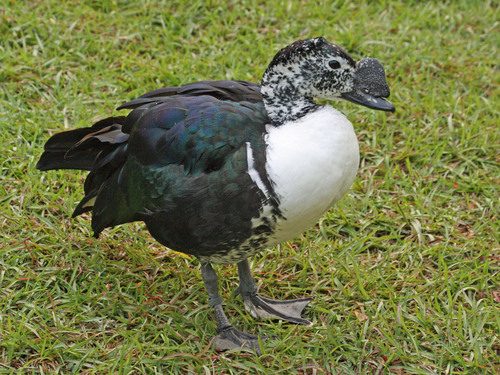
This common duck species is easy to distinguish from others, and is one of the largest duck species in existence. It ranges in length from 56 to 76 cm (22 to 30 in), has a wingspan of 116 to 145 cm (46 to 57 in), and weighs between 1.03 and 2.9 kg (2.3 to 6.4 lb). Adult individuals have a white head marked with dark freckles, a solid pure white neck, and pure white underparts. Their upperparts are glossy blue-black, with bluish and greenish iridescence that is especially noticeable on the secondaries, the lower arm feathers. Males are much larger than females, and have a large black knob on the bill. When viewed from a distance, immature knob-billed comb ducks can be mistaken for fulvous whistling ducks (Dendrocygna bicolor). However, immature knob-billed ducks are rarely found without adult individuals nearby, so they can usually be easily identified even when young. In terms of ecology, this species breeds in still freshwater swamps and lakes in the tropics. Most individuals do not migrate, only dispersing to new areas during the wet season. The duck feeds primarily on vegetation through grazing or dabbling; it eats small fish, invertebrates, and seeds to a smaller degree. It can become a nuisance for rice farmers. Knob-billed comb ducks often perch in trees. They are typically found in flocks, which are small during the wet season and can grow up to 100 individuals in the dry season. Flocks will sometimes separate by sex. For reproduction, comb ducks nest mainly in tree holes, and will also nest in tall grass. They line their nests with reeds, grass, or feathers, but do not use down to line nests. Males may have two mates at the same time, or up to five successive mates. Males defend females and young, but do not defend nest sites. Unmated males perch in trees and wait for mating opportunities. Females lay between seven and 15 yellowish-white eggs. Multiple females may lay their eggs in a single shared "dump nest" that can hold up to 50 eggs total.