About Sarcodes sanguinea Torr.
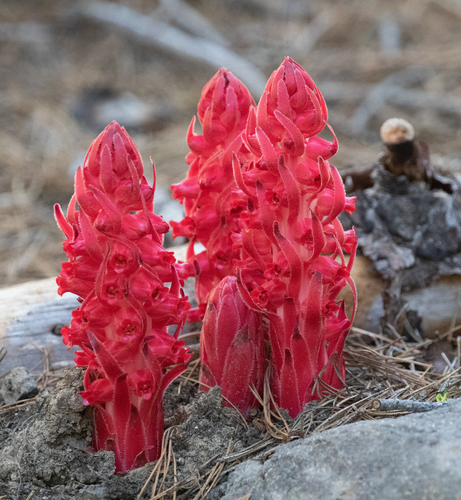
Sarcodes is a monotypic genus of flowering plants in the heath family Ericaceae, native to northwest North America. The genus contains only one species, Sarcodes sanguinea Torr., which is commonly known as the snow plant or snow flower. This species is a mycoheterotrophic parasitic plant that lacks chlorophyll and cannot perform photosynthesis. It gets all of its sustenance and nutrients from ectomycorrhizal fungi that attach to tree roots. Ectomycorrhizal symbioses are normally mutualisms: the plant partner provides fixed carbon to the fungus, and the fungus in turn provides mineral nutrients, water, and pathogen protection to the plant. The snow plant exploits this existing mutualism by tapping into the fungal network to steal sugars from the photosynthetic plant partner, a feeding strategy called mycoheterotrophy. It is host-specific, and can only form this relationship with the ectomycorrhizal Basidiomycete Rhizopogon ellenae. The only aboveground tissue produced by the plant is its inflorescence, which is a raceme of bright scarlet red flowers. This inflorescence is wrapped in many strap-like, pointed bracts with fringed edges; the bracts themselves are bright red to orange in color. S. sanguinea is native to montane regions of the California Floristic Province. Its range extends from the Oregon Cascade Range, as far north as the Umpqua River, south through the mountains of California including the Transverse Ranges, and into the Sierra de San Pedro Mártir range of northern Baja California. It is not found in the California Coast Ranges between the Klamath Mountains. The species epithet sanguinea refers to the plant's striking red inflorescence, which emerges from ground that is sometimes still snow-covered in early spring or summer. At higher elevations such as those of the High Sierra Nevada and Cascades, emergence may be as late as July. The genus name Sarcodes comes from the Greek word sarkódes (σαρκώδες), meaning 'fleshy'. According to botanist James L. Reveal, S. sanguinea is edible when cooked, and its root is reported to have a texture and flavor similar to asparagus.