About Sarcochilus falcatus R.Br.
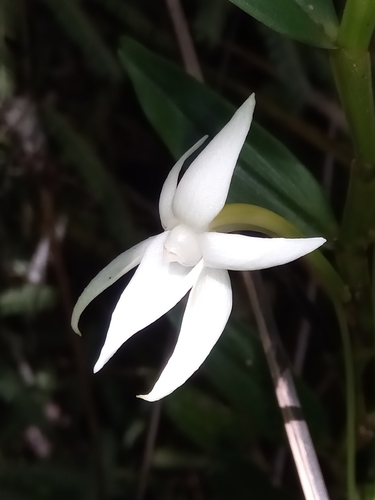
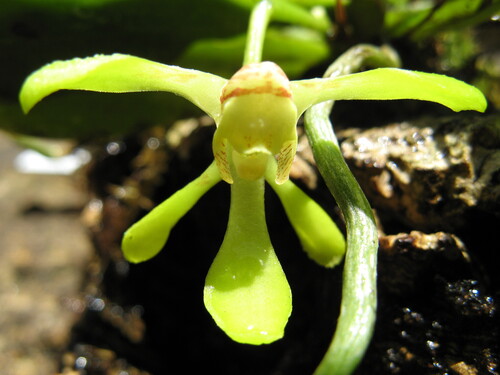
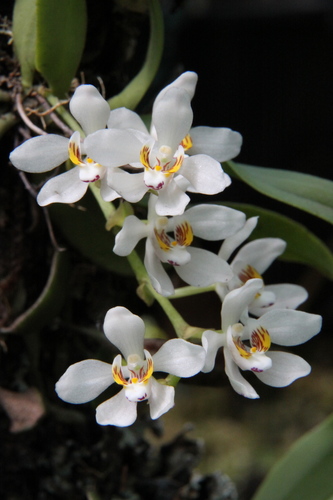
Sarcochilus falcatus, commonly called the orange blossom orchid, is a small epiphytic or lithophytic herb. Its stem grows 40 to 80 mm (2 to 3 inches) long, and bears between three and eight leathery, often curved leaves. The leaves measure 60 to 160 mm (2 to 6 inches) long and 15 to 20 mm (0.59 to 0.79 inches) wide, with fine teeth along their edges. Between three and twelve fragrant white to cream-coloured flowers, each 20 to 30 mm (0.79 to 1.2 inches) long and wide, are arranged on an arching flowering stem that is 70 to 180 mm (2.8 to 7.1 inches) long. The sepals and petals are egg-shaped, spread widely apart, and are 10 to 16 mm (0.39 to 0.63 inches) long and 5 to 7 mm (0.2 to 0.3 inches) wide. The labellum is white with orange and purple markings, 4 to 6 mm (0.16 to 0.24 inches) long, and has three lobes. The side lobes are erect, about 7 mm (0.3 inches) long and 5 mm (0.2 inches) wide, while the middle lobe is short and fleshy. Flowering occurs between June and October. This orchid grows on trees, and sometimes on rocks, usually in areas exposed to air movement, clouds, and drizzly weather. Its distribution ranges from Cedar Bay National Park in Queensland, south to the coast and nearby tablelands of New South Wales. It rarely occurs in the far north-eastern corner of Victoria. A species of Ceratobasidium was isolated from a specimen of S. falcatus collected near Dungog.