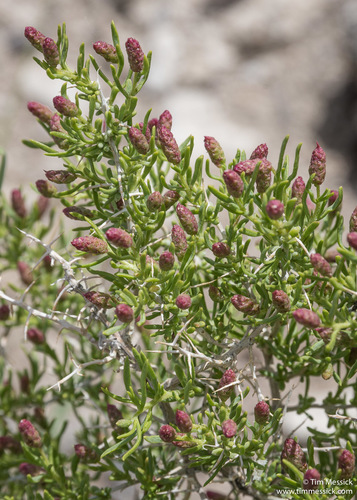
About Sarcobatus vermiculatus (Hook.) Torr.
Common Name and Growth Form
Sarcobatus vermiculatus, also known as greasewood, is a deciduous spiny shrub that reaches 0.5 to 3 metres in height.
Leaf Characteristics
It has green succulent leaves measuring 10–40 mm long and 1–2 mm broad; its green leaf color stands out from the grey-green foliage of most other shrubs growing in its native range.
Flower Traits and Flowering Period
This species produces unisexual flowers, with both male and female flowers borne on the same individual plant, and flowers appear between June and August.
Reproduction Methods
It reproduces both from seeds and from sprouts.
Formal Description Origin
This species was first formally described based on specimens collected in 1806 during the Lewis and Clark Expedition’s westward exploration of North America.
Distribution Range
Its natural distribution spans western North America: it ranges from southeastern British Columbia and southwestern Alberta in Canada, south through drier regions of the United States east as far as North Dakota and west Texas, west as far as central Washington and eastern California, and continues south to Coahuila in northern Mexico.
Genus Salt Tolerance Trait
Both known species in the genus Sarcobatus are halophytes.
Typical Habitat
Sarcobatus vermiculatus is typically found in sunny, flat landscapes around playa margins, as well as in dry stream beds and arroyos.
Saline Soil Adaptation and Habitat Partitioning
It tolerates salty soil by storing absorbed salt in its roots and leaves, but in the southwestern portion of its range, it is replaced by iodine bush in extremely saline environments like the hummocks found within playas themselves.
Alkaline Soil Indicator
Greasewood grows frequently on alkaline flats, and it is a reliable indicator of alkaline soil.
Stand Formation and Substrate Preference
It can form extensive, nearly pure stands in pluvial desert locations, and is most common on fine-grained soils in areas with a relatively high water table.
Grazing Toxicity
Adapted grazing animals can feed on this plant without issue, but grazing by sheep and cattle can cause oxalate poisoning that leads to kidney failure; the toxic oxalate involved is either sodium oxalate or potassium oxalate, and sheep are the most vulnerable to poisoning.
Wood Characteristics
The wood of this species is yellow, very hard and tough.
Historical Arrow Shaft Use
Due to its hardness, it was historically used to make arrow shafts.
Firewood Use
Native Americans and early European settlers also used it as firewood.
Traditional Navajo Use
Navajo people traditionally use it to make stirring sticks called Ádístsíín.


