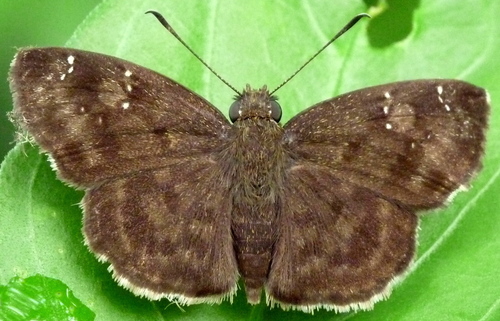
About Sarangesa dasahara (Moore, 1865)
Scientific name: Sarangesa dasahara (Moore, 1865)
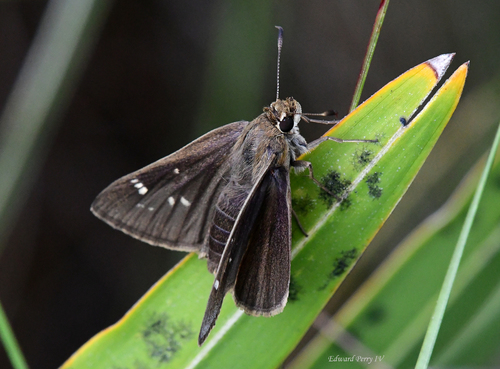
Description: Male. The upperside is colored similarly to Sarangesa purendra, but is slightly darker. The forewing has three sub-apical dots matching those of S. purendra, a tiny dot at the upper end of the cell, another dot above this one, a very indistinct discal band, and faint markings suggesting a similar middle band; both bands are only very slightly darker than the base wing color. The hindwing has faint indications of a discal band and a marginal band. The underside is much paler, so the bands are more distinct. The hindwing has some grey suffusion between the bands and along the abdominal area, created by tiny greyish-white scales. The cilia match those of S. purendra.
Female is similar to the male, but the forewing has an extra dot below the cell, with all three dots aligned in a line. There is also an additional dot in the second median interspace, located a little before the middle of that interspace. The underside has matching markings, with the same coloration and bands seen in the male. Antennae, palpi, body, and legs are very similar to those of S. purendra.
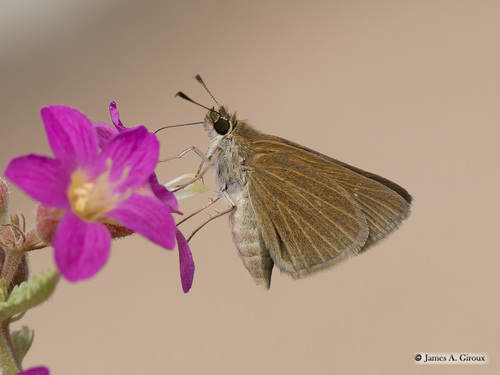
This species, the common small flat, has a wingspan of around 30–35 mm. It is a dull black or brown butterfly, with a semi-transparent spot on the wings, and sometimes has no visible spots at all. The underside of the wings is grey brown with diffused dark spots. Males and females are similar in shape and color, with barely any differentiation between the two sexes. Both sexes of the flat are similar in overall appearance: they are dull brownish black on the upperside, and greyer in color on the underside. The butterflies have small, semi-transparent discal, cell, and apical spots. The dark spots on the underside of the forewing are large, dark, and diffused.
Status, distribution and habitat: This species is most commonly seen at the end of the rainy season, and is only sparsely found in post-monsoon months. It is common but not abundant in most habitats. In contrast, the related spotted small flat (Sarangesa purendra) is more common in arid regions. Sarangesa dasahara occurs in openings and edges of evergreen forests, semi-evergreen forests, deciduous forests, and scrub and short grassland savannahs. It can be found in the Deccan plains and also in hills, but occurs more frequently at lower elevations. Except for the very dry north-west India, it is common throughout India, and also occurs in Sri Lanka and the Indo-Chinese region.