About Saponaria officinalis L.
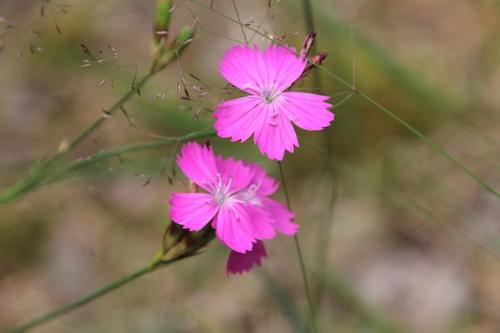
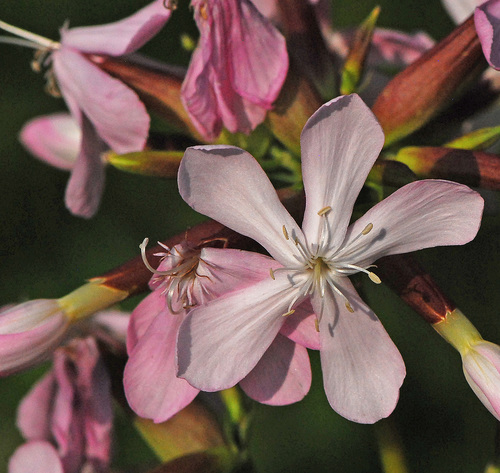
Saponaria officinalis L. has leafy, unbranched stems that are often tinged red, and grows in patches reaching up to 70 cm (28 in) in height. Its broad, lanceolate, sessile leaves grow in opposite pairs, and measure between 4 and 12 cm long. This species produces sweetly scented, radially symmetrical flowers that are typically pink, and occasionally white. Each of the flower’s five flat petals has two small scales in the corolla throat. Individual flowers are around 2.5 cm (1 in) wide, and arranged in dense terminal clusters on the main stem and its branches. The long tubular calyx has five pointed red teeth. Individual flowers open in the evening and stay open for around three days. They produce a stronger scent at night and increase nectar production during nighttime hours. The flowers are protandrous: pollen is released on the second night of blooming, and the stigma develops to its final position by the third night. Most seed production occurs via self-pollination. A variety of insects visit the flowers, including Noctuidae, Sphingidae, bumblebees, and hoverflies. In the Northern Hemisphere, this species blooms from May to September, while in the Southern Hemisphere it blooms from October to March. For external use, as its common name suggests, Saponaria officinalis can be used as a very gentle soap, typically prepared as a dilute solution. It has been used historically to clean delicate or specialty textiles, especially woollen fabrics, and it has been hypothesized that this plant was used to treat the Shroud of Turin. A lathery liquid capable of dissolving fats or grease can be obtained by boiling the plant’s leaves or roots in water. To make the soap, leaves are chopped, boiled, and strained, and the resulting liquid can be used directly as soap. In the Romanian village of Șieu-Odorhei, local people call the plant săpunele, and it is traditionally used as a soap replacement for dry skin. For internal use, an overdose of this plant can cause nausea, diarrhea, and vomiting. Despite this toxic potential, Saponaria officinalis has culinary uses: it acts as an emulsifier in commercial tahini production, and is used in brewing to create beer with a good head. In the Middle East, the root is often added when making halva, where it helps stabilize the oils in the mixture and creates halva’s distinctive texture.