About Saponaria ocymoides L.
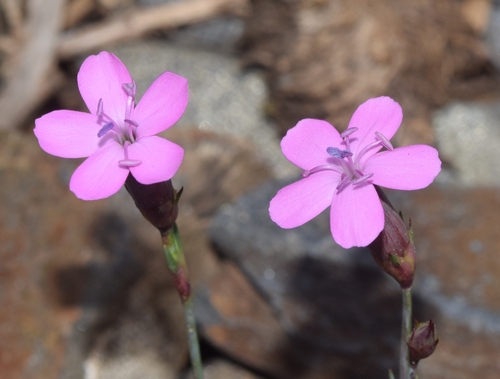
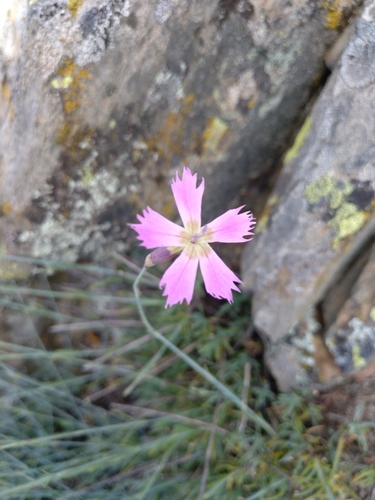
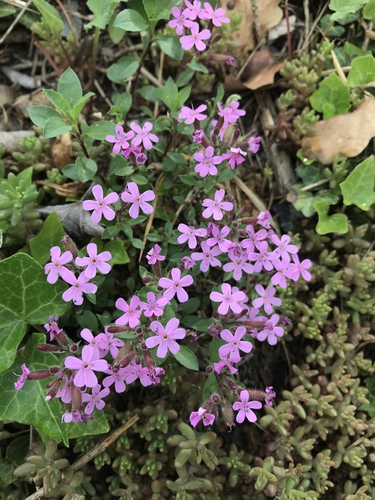
Saponaria ocymoides L. grows 10 to 40 centimeters (3.9 to 15.7 inches) tall. Its stems are prostrate to ascending, woody, reddish, quite hairy, and heavily branched. The leaves are ovate to lanceolate, sessile, hairy, and measure 1 to 3 centimeters long. Its five-petaled flowers grow in clusters at the ends of branches; petals are red or pink, rarely white, and anthers are blue. Its sepals are fused into a tube 8 to 10 millimeters long. In the Northern Hemisphere, its flowering season runs from May through August. Its fruit is an ovoid capsule, reaching up to 9 millimeters in length. This species is distributed from the mountains of Spain through Corsica, Sardinia, and Slovenia, and from the Apennines to the Alps. It grows in rocky and stony locations, dry slopes, and forests, particularly pine forests, and prefers calcareous (alkaline) soils. It grows at elevations up to 1,500 meters (4,900 feet), and rarely reaches up to 2,400 meters (7,900 feet). Saponaria ocymoides is cultivated as an ornamental plant for rock gardens and dry stone walls, and grows best in well-drained alkaline or neutral soil located in full sun. Like most alpine plants, it is harmed by excess winter moisture around its roots. This plant has been awarded the Royal Horticultural Society's Award of Garden Merit.