About Sapindus saponaria L.
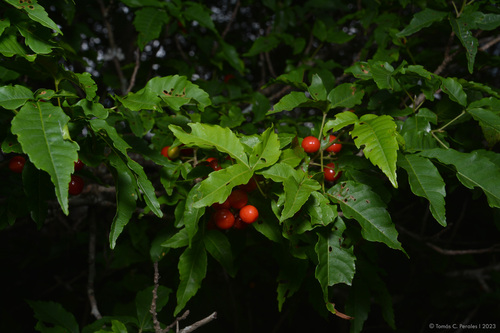
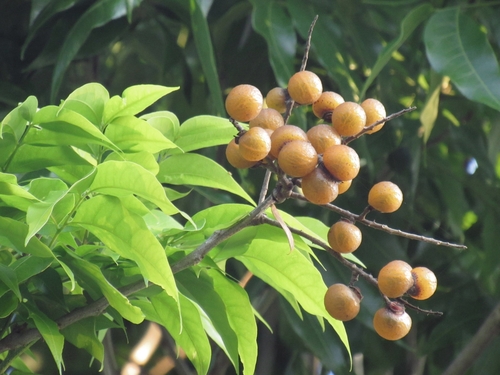
Sapindus saponaria L., commonly known as western soapberry, often grows in clumps or thickets, reaching about 20 ft (6.1 m) in height in the western part of its range. Solitary trees can grow as tall as 50 ft (15.2 m). In the western part of its range, it is most often found growing at the head of prairie ravines, the margins of woodlands, the edges of fields, or on rocky hillsides. Its leaves are alternate, pinnately compound, thick and leathery, deciduous, and 8 in (20 cm) to 15 in (38 cm) in length. Each leaf is made up of 6 to 20 narrow lanceolate leaflets that have smooth margins, long tapered tips, and uneven wedge-shaped bases; leaflets measure 2 in to 5 in (5 cm to 13 cm) long and 0.75 in to 1.5 in (2 cm to 3.8 cm) wide. Midveins on leaves of S. saponaria var. saponaria are mostly winged, while those of var. drummondii are never winged. The inflorescences are dense terminal panicles of small white flowers 6 in to 10 in (15 cm to 20 cm) long. Flowering occurs in May–June for var. drummondii and in November for var. saponaria. Fruits grow in large pyramidal clusters at the ends of branches. Each golden fruit is between 1.2 in to 1.4 in (3 cm to 3.6 cm) in diameter; it becomes translucent and wrinkled when fully mature and contains a single black seed about 0.35 in (9 mm) in diameter. Fruits of var. drummondii ripen in October and often remain on the tree until spring, while those of var. saponaria ripen in spring. The twigs of var. drummondii are gray-brown and hairy with short tan-colored hairs, while those of var. saponaria are gray and hairless. Buds on var. drummondii are small, dark brown, and hairy, while those on var. saponaria are small, brown, and hairless. The trunk of var. drummondii has light gray, scaly bark formed as thin plates, and is sometimes shallowly furrowed, while var. saponaria has gray to reddish-colored scaly bark. Western soapberry has remarkable yellow-colored sapwood that contrasts sharply with its heartwood. In the Plains Apache language, the wood is called chishłítsowe, meaning 'yellow wood'. This species has a very wide native range throughout the Americas, ranging from Kansas (with isolated populations known as far north as Montana, Colorado, and Missouri) east to Florida and the West Indies, and south to Paraguay. Isolated populations are also found on oceanic islands, including Clarion Island, the Galápagos Islands, and the Hawaiian Islands. The fruit of Sapindus saponaria var. drummondii are poisonous and can cause skin rashes; they have been used to stupefy fish. The foliage may also be toxic to livestock. Western soapberry wood is very hard, heavy, elastic, and close-grained—properties that give the tree excellent resistance to the extreme winds of the southern Great Plains. For these reasons, the wood was highly esteemed by the indigenous Plains Apache people of Oklahoma, who used it to make tent poles, bows and arrows, and tool handles. It was said that tent poles made from the branches of this wood would last indefinitely if seasoned. The fruits can contain as much as 37% saponin, and when macerated in water they produce a soapy lather. Formerly, they were widely used in Mexico and other regions for laundering clothes. The dark round seeds are made into buttons and necklaces. The wood splits easily and is made into baskets.