About Sannantha pluriflora (F.Muell.) Peter G.Wilson
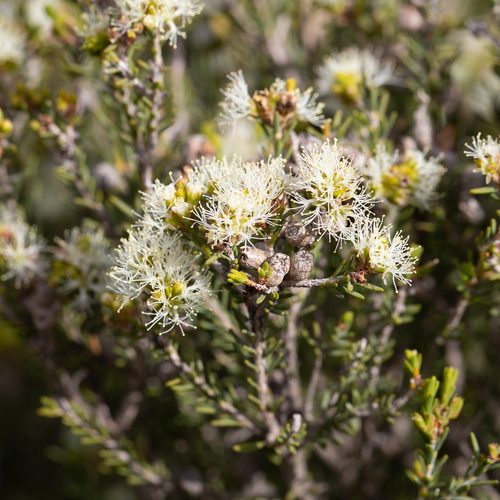
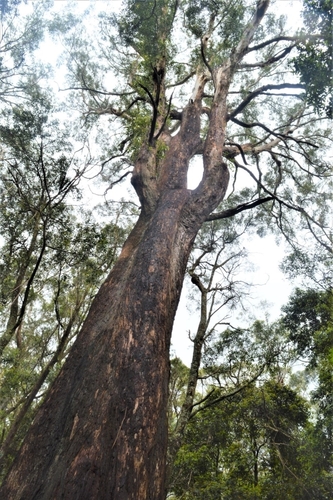
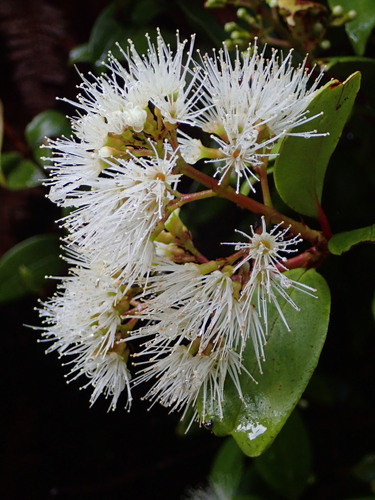
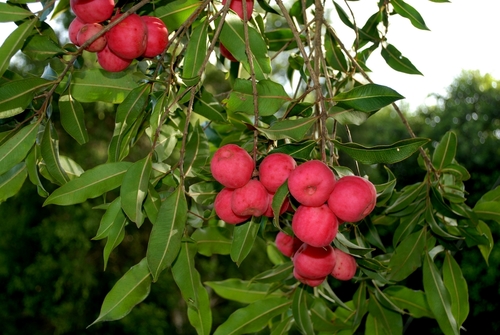
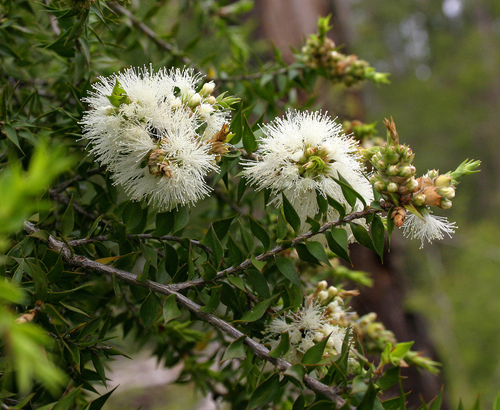
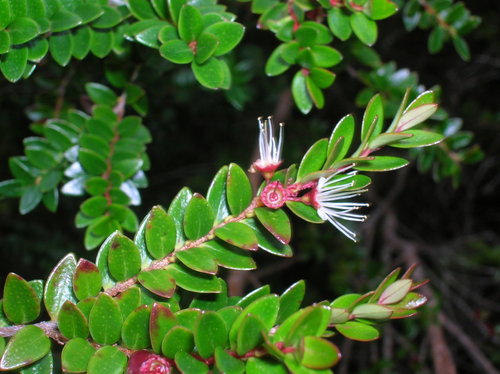
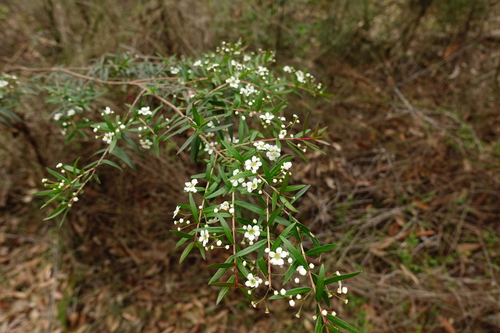
Sannantha pluriflora (F.Muell.) Peter G.Wilson is an erect shrub or small tree that usually grows 2 to 4 meters (6 feet 7 inches to 13 feet 1 inch) tall. Its branchlets have a roughly square cross-section. The leaves are lance-shaped to elliptic, measuring 7 to 30 millimeters (0.28 to 1.18 inches) long and 1.0 to 6.5 millimeters (0.039 to 0.256 inches) wide, and grow from a petiole 0.8 to 1.5 millimeters (0.031 to 0.059 inches) long. The leaves have prominent oil glands, which are particularly visible on the lower leaf surface. The flowers reach up to 10 millimeters (0.39 inches) in diameter, and are arranged in clusters of two to nine in leaf axils. These clusters sit on a peduncle 5 to 13 millimeters (0.20 to 0.51 inches) long. Each individual flower grows on a pedicel 3 to 7 millimeters (0.12 to 0.28 inches) long, with linear bracteoles up to 1.2 millimeters (0.047 inches) long at the flower base. The floral tube is roughly smooth, and the sepal lobes grow up to 0.6 millimeters (0.024 inches) long. The petals are white, broadly egg-shaped to round, and 2.5 to 3.7 millimeters (0.098 to 0.146 inches) long. Each flower has between 8 and 15 stamens. Flowering occurs mainly from October to January, and the fruit is a capsule 2.5 to 3.5 millimeters (0.098 to 0.138 inches) in diameter. Sannantha pluriflora most commonly grows in forest near streams. It is widespread on the coast and adjacent tablelands of New South Wales, from south of Port Stephens to Gippsland in eastern Victoria.