About Sanguinaria canadensis L.
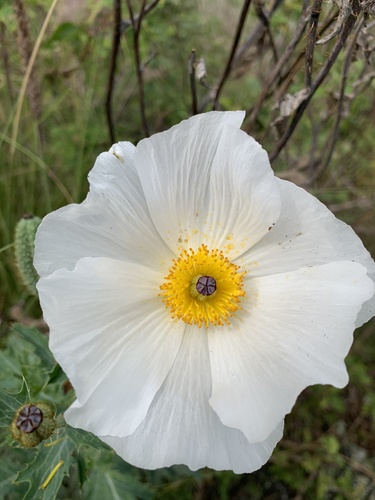
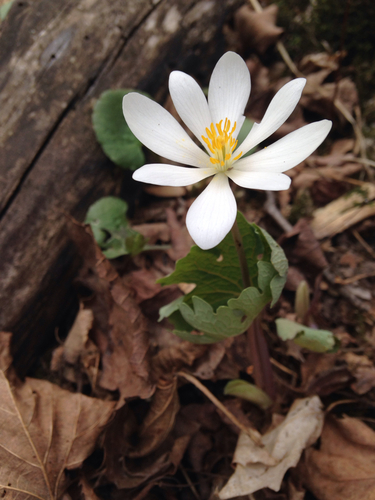
Sanguinaria canadensis L., commonly known as bloodroot, grows 20 to 50 cm (8 to 20 in) tall. It produces one large basal leaf, up to 25 cm (10 in) across, marked with five to seven lobes. Both leaves and flowers sprout from a reddish rhizome that contains bright orange to red sap; this sap color gives the genus its name Sanguinaria, from the Latin word sanguinarius meaning 'bloody'. The rhizomes lengthen each year and branch to form spreading colonies. Bloodroot begins blooming before its foliage unfolds in early spring; after flowering finishes, the leaves unfurl to their full size. Unlike many other spring ephemerals, it goes dormant in mid to late summer. Flowers bloom from March to May, depending on local region and climate. Each bloom has 8–12 delicate white petals, numerous yellow stamens, and two sepals located below the petals that drop off after the flower opens. As the flower stem emerges from the ground, it is clasped by the plant’s leaf. Flowers open in sunlight and close at night, and are pollinated by small bees and flies. Seeds develop in green pods that are 4 to 6 cm (1+1⁄2 to 2+1⁄4 in) long, and ripen before the plant’s foliage goes dormant. Ripe seeds are round, range in color from black to orange-red, and have white elaiosomes that are eaten by ants. The Latin specific epithet canadensis means 'of Canada'. Bloodroot is native to eastern North America, ranging from Nova Scotia south to Florida, and west to the Great Lakes and down the Mississippi embayment. It grows in moist to dry woods and thickets, often found on floodplains, near shores or streams, and on slopes. It grows less commonly in clearings, meadows, or on dunes, and is rarely found in disturbed sites. Bloodroot is one of many plants that relies on ants to spread its seeds, a process called myrmecochory. Its seeds have a fleshy organ called an elaiosome that attracts ants. Ants carry the seeds back to their nest, where they eat the elaiosomes, and place the leftover seeds in the nest’s debris. The seeds are protected there until they germinate, and gain additional benefit from growing in the nutrient-rich medium of ant nest debris. Bloodroot flowers produce pollen but no nectar. A variety of bees and flies visit the flowers searching unsuccessfully for nectar; these include sweat bees in the genera Lasioglossum and Halictus, cuckoo bees in the genus Nomada, small carpenter bees (Ceratina), and bee flies in the genera Bombylius and Brachypalpus. Some insects visit to collect pollen, including mining bees (Andrena), which are the plant’s most effective pollinators, and at least one beetle species, Asclera ruficollis. The plant’s bitter, toxic leaves and rhizomes are not often eaten by mammalian herbivores. Bloodroot produces benzylisoquinoline alkaloids, with the primary toxin being sanguinarine. These alkaloids are transported to and stored in the rhizome. Sanguinarine kills animal cells by blocking the action of Na+/K+-ATPase transmembrane proteins. As a result, applying bloodroot to the skin can destroy tissue and lead to the formation of necrotic tissue called an eschar, so bloodroot and its extracts are classified as escharotic. Although applying escharotic agents including bloodroot to the skin is sometimes promoted as a pseudoscientific home treatment for skin cancer, these attempts can cause severe disfigurement. Salves derived from bloodroot, most notably black salve, do not remove tumors. Microscopic tumor deposits may remain after visible tumor tissue is burned away, and case reports show that tumors can recur and/or metastasize in these instances. Internal use of bloodroot is not recommended; an overdose of bloodroot extract can cause vomiting and loss of consciousness. Sanguinaria canadensis is cultivated as an ornamental plant. Double-flowered forms are prized by gardeners for their large, showy white flowers that bloom very early in the gardening season. The flower petals of standard bloodroot are shed within one or two days of pollination, so the flower display is short-lived, but double-flowered forms bloom much longer than normal forms. Double flowers are formed from stamens that have been modified into petal-like structures, which makes pollination more difficult. The double-flowered cultivar S. canadensis f. multiplex 'Plena' has earned the Royal Horticultural Society's Award of Garden Merit. Historically, Native Americans used bloodroot for its believed curative properties, as an emetic, respiratory aid, and for other treatments. Commercial uses of sanguinarine and bloodroot extract include use in dental hygiene products. Some animal food additives sold and distributed in Europe contain sanguinarine and chelerythrine.