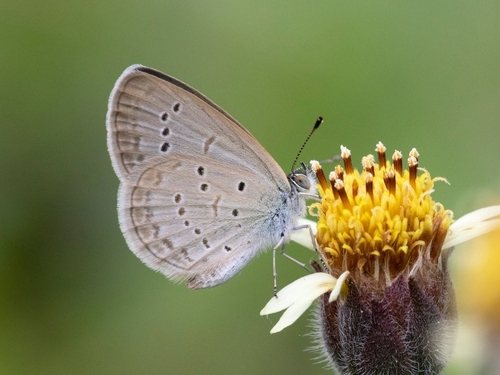
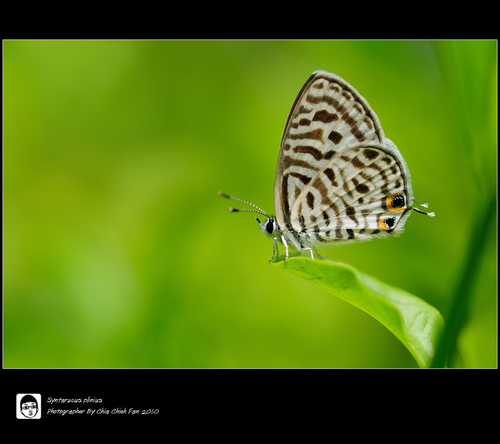
About Sandia mcfarlandi (Ehrlich & Clench, 1960)
This species, originally published as C. mcfarlandi, is currently classified as Sandia mcfarlandi. It is a relatively small butterfly with tailless wings that measure 2.9–3.2 cm (1 1/8 to 1 1/4 inches) across. On the dorsal side, female wings are generally reddish-brown with a narrow black border along the edge, while male wings are typically brown. The underside of the wings of both sexes is usually greenish-yellow, with a postmedian line bordered in black near the wing base. This species is polymorphic, so some individuals have phenotypes that differ significantly from this general description. According to one simple description, the butterfly is small, gold and green in color, and lives among beargrass plants. Its pink, lavender and white caterpillars eat beargrass flowers, which makes both the butterfly and its caterpillar easy to identify. A butterfly hunter writing for Orion magazine described this butterfly as a hairstreak: the name comes from the tiny tails many hairstreak species trail from their hindwings, the stripes that appear on many species, or possibly from their fast, zippy flight. Many hairstreaks emerge early in the season and are not seen again afterward. This species is goldy-green with a white stripe on its underside, which lets it blend perfectly with its larval host plant. The author found both the plant and butterfly at the type locality, the place of the species' original collection and description: the Sandia Mountains outside Albuquerque. The author noted the sharp contrast between the beargrass mount habitat, the large nearby casino, and the city that lies beyond. Hairstreaks like this one, with their specific botanical requirements and reliance on moist spring conditions, may be among the first butterflies affected by regional warming and drying, and the first to abandon their historical ranges. As of this account, the butterfly still persists in the Sandia Mountains. The Sandia hairstreak has a limited range, found in yucca-agave desert in the Southwestern United States from southeast Colorado south through New Mexico and western Texas, and also in northeast Mexico. For its life cycle: in March, females lay eggs on the stalks of Texas sacahuista (Nolina texana). The caterpillars are naturally monophagous, feeding only on this plant, and eat both its flowers and its fruit during April. In May, caterpillars crawl into the leaf litter under the host plant and form a chrysalis. Adult butterflies emerge the following spring. After emerging, adults feed on nectar from the same host plants used by their larvae, then search for mates. An entomologist at the University of California, Riverside, discovered that this species can be raised in the laboratory on Lotus scoparius with little to no developmental retardation. This contrasts with other picky lycaenid butterfly species that do not survive or develop well on non-native host plants. This laboratory finding suggests that the species' ancestral range was once much larger than its current range.