About Sambucus nigra L.
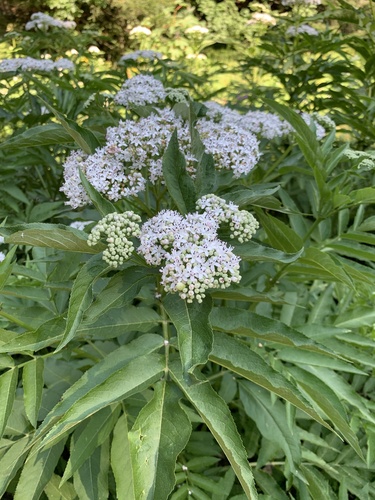
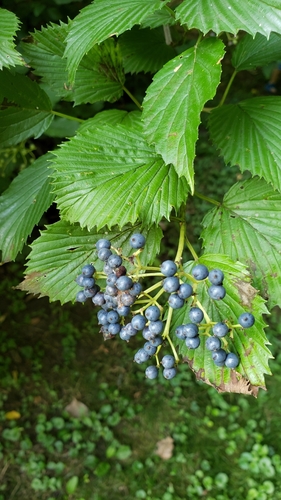
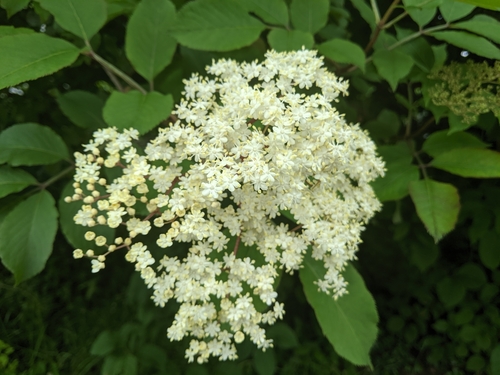
Sambucus nigra L., commonly known as elderberry, is a deciduous shrub or small tree that usually grows 6 meters (20 feet) tall and wide, and rarely reaches 10 meters (33 feet) in height. When young, its bark is light gray; mature bark becomes coarse gray with lengthwise furrowing and prominent lenticels. Its leaves are arranged in opposite pairs, measuring 10–30 centimeters (4–12 inches) long, and are pinnate with five to seven (rarely nine) leaflets. Each leaflet is 5–12 centimeters (2–4 3/4 inches) long and 3–5 centimeters (1 1/4–2 inches) wide, with a serrated margin. Young stems of this plant are hollow. The hermaphroditic flowers, which have five stamens, grow in large, flat corymbs 10–25 centimeters in diameter from late spring to mid-summer. Individual flowers are ivory white, 5–6 millimeters (3/16–1/4 inch) in diameter, have five petals, and are pollinated by flies. The fruit is a glossy dark purple to black berry 3–5 millimeters in diameter, produced in drooping clusters in late autumn. The dark color of elderberry fruit comes from its high phenolic content, especially anthocyanins. Sambucus nigra is native to Europe, ranging east as far as Turkey, and is native and common throughout the British Isles. It has been introduced to parts of most other continents worldwide. Its typical habitats are hedges, waste ground, roadsides, and woods, and it is recorded as very common in Ireland, growing as scrub in woodland hedges. Like other elderberries, Sambucus nigra can be infected by elder whitewash fungus and jelly ear fungus. The strong-scented flowers of wild Sambucus nigra populations attract many minute flower thrips, which may help transfer pollen between different inflorescences. Many parts of the elderberry plant, including its fruit, contain phytochemicals such as alkaloids, lectins, and cyanogenic glycosides, which may be toxic if consumed raw. The seeds and all green parts of the plant contain cyanogenic glycosides. Eating unprepared berries, leaves, bark, or stems may cause nausea, vomiting, and severe diarrhea. Elderberry plant materials or products should not be consumed during pregnancy, or by people with plant allergies or gastrointestinal diseases. Elderberry products may cause adverse effects when used alongside prescription drugs. Sambucus nigra is a very common sight in hedgerows and scrubland across Britain and northern Europe. Some selected varieties and cultivars have variegated or colored leaves and other distinctive traits, and are grown as ornamental plants. S. nigra f. porphyrophylla has dark maroon to black leaves and pale pink flowers. Three cultivars have received the Royal Horticultural Society's Award of Garden Merit: S. nigra f. laciniata (cut-leaved elder), S. nigra f. porphyrophylla 'Eva' (sold as 'Black Lace'), and S. nigra f. porphyrophylla 'Gerda'. Raw dark blue or purple elderberries are mildly poisonous, but become edible after cooking. Cooked berries can be used to make jam, jelly, chutney, and Pontack sauce. In Scandinavia and Germany, elderberry soup, such as the German Fliederbeersuppe, is a traditional dish. Elderflower heads are commonly used to make infusions for drinks across Northern Europe and the Balkans; these drinks are sold commercially as elderflower cordial or elderflower pressé. In Europe, flowers are processed into syrup or cordial, known as socată in Romanian, fläder(blom)saft in Swedish, and hyldeblomstsaft / hyldedrik in Danish, which is diluted with water before drinking. The recent popularity of this traditional drink has led commercial soft drink producers to release elderflower-flavored products like Fanta Shokata and Freaky Fläder. Flowers can also be dipped in light batter and fried to make elderflower fritters. Berries can be fermented into elderberry wine. In Hungary, elderberry brandy is produced, requiring 50 kilograms of fruit to make 1 liter of brandy. In south-western Sweden, it is traditional to make an elderflower-flavored snaps liqueur. Elderflowers are used in liqueurs such as St-Germain, and to make a mildly alcoholic sparkling elderflower 'champagne', though a stronger homemade version can also be made. In Beerse, Belgium, a type of jenever called beers vlierke is made from elderberries. This plant is used in traditional medicine by native peoples and herbalists. Extracts of the flowers and fruits are used to relieve cold and flu symptoms, though there is no high-quality clinical evidence that it is effective for treating any disease.