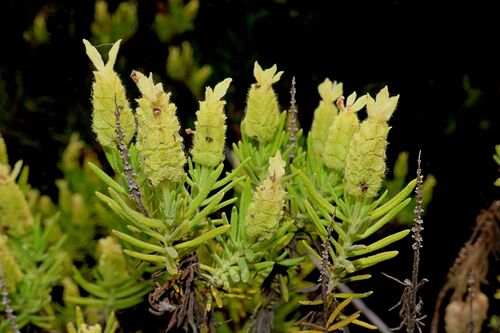
About Salvia tiliifolia Vahl
Salvia tiliifolia Vahl, commonly called lindenleaf sage or Tarahumara chia, is a vigorous herbaceous annual plant in the mint family Lamiaceae, native to Central America (Mesoamerica). It grows as a pioneer species in disturbed areas, and has spread beyond its native range in modern times. It is now found as far south as Peru and Bolivia in South America, in the southwestern United States including Texas and Arizona, in Africa including South Africa and Ethiopia, and in China including the provinces of Yunnan and Sichuan. It has become naturalized or invasive in Mexico, the United States, Ethiopia (since the 1980s), South Africa (since 1943), and China (since the 1990s). In Ethiopia, it arrived in grain distributed as humanitarian aid after extended droughts, then spread rapidly, displacing native herbs in some locations. Its uncontrolled spread in Ethiopia is partially due to its strong aroma, which causes grazing and browsing animals to avoid it. It commonly grows in cultivated fields.
Related chia species similar to S. tiliifolia were domesticated as early as 3400 BCE, and chia was an important food in the Aztec diet, widely used by Aztec people. S. tiliifolia is still harvested today by the Tarahumara people. Aztecs roasted the chia seeds, mixed them with amaranth seed, corn flour, and maguey syrup to make a dough called "tzoalli" in the Nahuatl language, which was regularly eaten and is still consumed today. Roasted seeds were also ground into flour to make a drink called "chianatolli." The Tarahumara add roasted S. tiliifolia seeds to a drink called "chia fresca." When soaked, chia seeds release a thick mucilage. The word "chia" translates to "strength" from the Mayan language, and the seed is valued as an energy-rich food. It contains high amounts of Omega-3 fatty acids, iron, calcium, and antioxidants. Its energy is released slowly during digestion, as carbohydrates are broken down and converted to sugar. The Tarahumara people credit their long-distance running ability to consumption of chia.
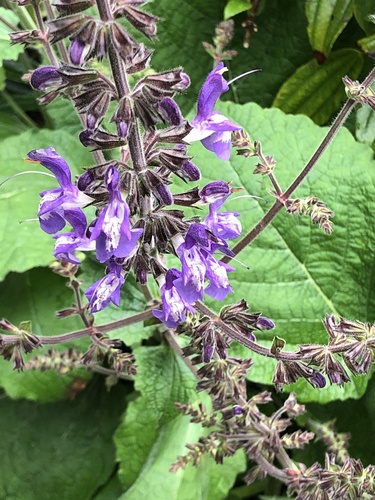
Salvia tiliifolia reaches up to 1 meter (3.3 feet) in height. Its leaves are ovate with petiolate blades, measuring 5 to 10 cm (2.0 to 3.9 in) long and 4 to 9 cm (1.6 to 3.5 in) wide. Leaf surfaces are slightly pubescent; veins are deeply recessed on the upper leaf surface and protruding on the lower surface. Leaf margins are finely and regularly crenate, and the leaves strongly resemble the leaves of the linden tree (genus Tilia), which gives the species its name. The plant's inflorescence may be simple or paniculate, with a hispid, ribbed calyx. The dark blue corolla is 5 to 10 mm (0.20 to 0.39 in) long. It is morphologically similar to Salvia personata. Its seeds are small, dark, and patterned. This species was first described by botanist Martin Henrichsen Vahl in 1794 under the name Salvia tiliaefolia.