About Salvia splendens Sellow ex Nees
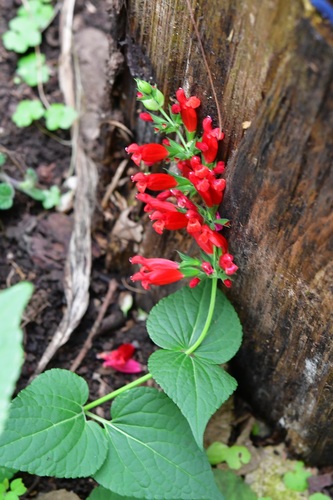
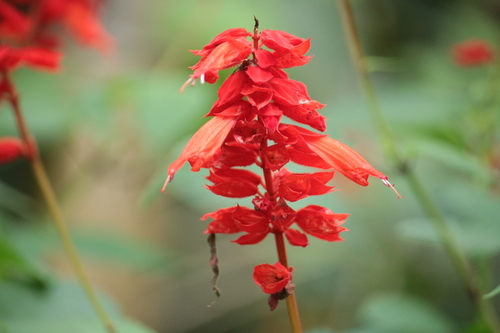
The native wild-type Salvia splendens is rarely used or described. Wild-type plants grow 1.5 to 8 m (4.9 to 26.2 ft) tall. Their leaves are arranged oppositely, are elliptical in shape, measure 7 × 5 cm, have toothed margins, and grow on long petioles. Plants may produce branches: upper branches are covered in fine hairs, while lower plant parts are hairless. Erect flower spikes emerge from the centre of the plant, with 2 to 6 flowers growing from each leaf node. Flowers are scarlet, tubular or bell-shaped, 35 mm long, and have two lobes near the apex; the upper lobe is 13 mm long. Flowering occurs through most of summer and autumn. This species is widely cultivated as an ornamental plant, with many cultivars selected to produce flowers in colours ranging from white to dark purple. It is a subtropical species that cannot survive freezing temperatures, but can be grown as an annual plant in cold climates. The most common cultivated selections are dwarf varieties, such as 'Sizzler' and 'Salsa', which are planted in large groups in gardens and commercial mall landscapes. The cultivar 'Van Houttei' reaches 1 to 1.3 m (3.3 to 4.3 ft) in height. Most cultivated types of Salvia splendens typically bear red flowers.