About Salvia sonomensis Greene
Scientific Naming and Common Name
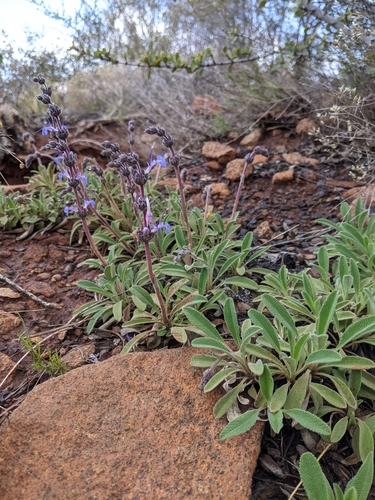
Salvia sonomensis Greene, commonly known as creeping sage, is a mat-forming subshrub.
Stem and Inflorescence Size
Its stems grow up to around 30 cm (12 inches) tall, and its 15 cm (5.9 inch) inflorescences rise above the foliage.
Trait Variability
This species is highly variable in leaf shape, leaf size, and flower color.
Leaf Characteristics
Leaves may be long and narrow, or shorter and rounded, and leaf color ranges widely from yellow-green to gray-green.
Flower Coloration
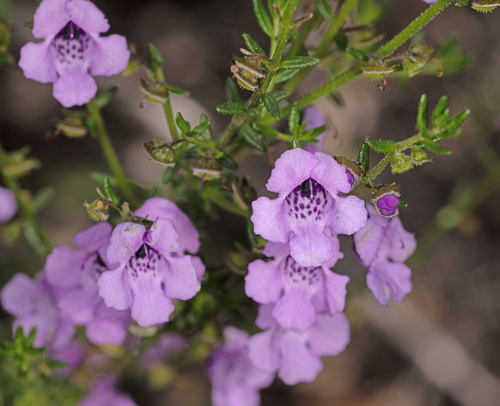
Flowers can be pale lavender, lavender-purple, or lavender-blue.
Geographic Distribution
This species occurs in three separate regions of California: the California Coastal Range from Siskiyou to Napa County, from Monterey County to San Diego County, and the Sierra Nevada foothills.
Elevation and Habitat
It grows at elevations below 2,000 m (6,600 ft) on dry hillsides and in woodlands.
Cultivation Requirements
Salvia sonomensis is easy to cultivate, except it does not grow well in heavy clay soils or locations with excessive irrigation.
Cultivated Variety Background
Multiple cultivated varieties exist, selected based on differing leaf traits and flower colors.
Hardy Cultivars
Two particularly hardy cultivars, 'Cone Peak' and 'Serra Peak', were selected from high elevation populations.
White-Flowered Cultivar
'John Farmar-Bowers' is a white-flowered variety.
Interspecific Hybrids
Two hybrids, 'Dara's Choice' and 'Mrs. Beard', are thought to be crosses between Salvia sonomensis and Salvia mellifera.
Phytochemical and Use Property
In his book Pharmako/poeia, Dale Pendell states that Salvia sonomensis contains a camphor-like substance that acts as a mild stimulant when smoked.