About Salvia sagittata Ruiz & Pav.
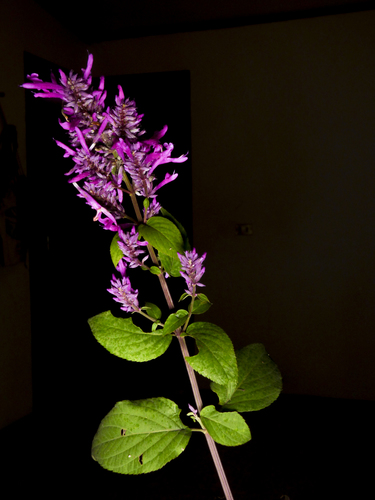
Salvia sagittata is a herbaceous perennial plant species belonging to the Lamiaceae family. It is native to the Andes Mountains, where it grows at elevations between 2,900 and 3,200 meters (9,500 to 10,500 ft). The species’ specific epithet references its arrow-shaped leaves. This plant was collected and formally named in 1798 by Hipólito Ruiz López and José Antonio Pavón Jiménez, two Spanish botanists. The pair spent ten years in Peru and Chile on a Spanish government commission, sent to the New World to search for new medicinal and agricultural plants. In the wild, Salvia sagittata reportedly grows to 2.3 m (7.5 ft) tall, reaching just 0.76 m (2.5 ft) when grown in cultivation. It is covered in yellow-green leaves, which are textured and wrinkled (rugose) on their upper surface. The undersides of the leaves are covered in short white hairs and have prominent, heavy veining. Its inflorescences are very sticky, and can grow up to 0.61 m (2 ft) long above the leafy stems. Its 2.5 cm (1 in) flowers are a striking brilliant blue, with a spreading lower lip. One pistil and two yellow stamens are visible in the upper lip of the flower.