About Salvia runcinata L.f.
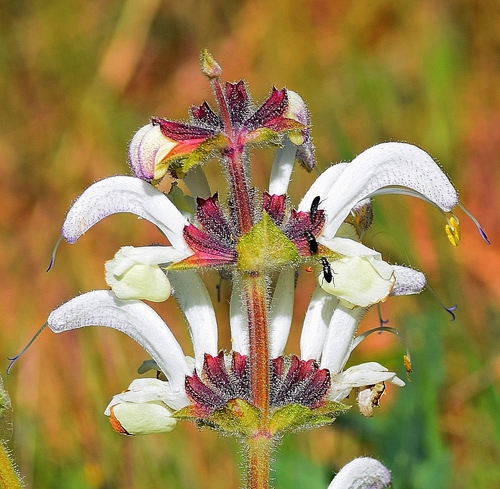
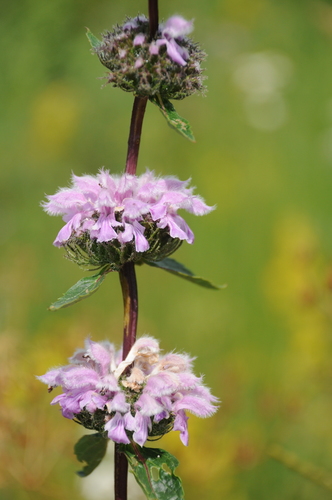
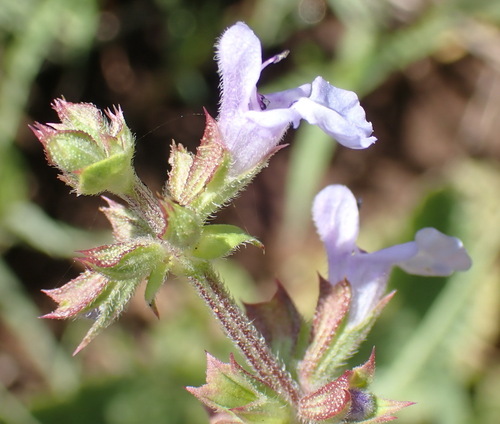
Salvia runcinata L.f. is a perennial erect herb that grows 15–50 cm (6–20 in) tall. It produces one to several stems that grow from a taproot, or occasionally from a creeping rootstock. Stems are hispid to crisply hairy and marked with gland dots. Leaves have short petioles, though upper leaves are sometimes sessile. Leaf blades range from runcinate-pinnatipartite to lyrate, and are rarely almost entire; they are oblong-lanceolate to obovate in outline, measuring 30–90 mm (1.2–3.5 in) or more long, and 15–30 mm (0.6–1.2 in) or more wide. Leaves are rough-hairy, gland-dotted, and have rounded to triangular lobes. The inflorescence is made up of several to many verticillasters, which are widely spaced in the lower section and denser toward the top; each verticillaster holds 4–8 flowers. The calyx is roughly hairy, gland-dotted, and 5–8 mm (0.2–0.3 in) long. The corolla is white, or ranges from pale blue to mauve or purplish, and is 7–14 mm (0.28–0.55 in) long. The corolla tube is 4.5–9 mm (0.18–0.35 in) long, with a straight upper lip and a lower lip that is usually slightly longer. Salvia runcinata flowers from October to April. Salvia runcinata is extremely variable in form, and the boundaries of the species are not well understood. Its closest relative is Salvia stenophylla, and it can be very difficult to distinguish some forms of S. runcinata from that species, or from Salvia repens. In his revision of African Salvia species, botanist Ian Hedge noted that "the range of variation suggests that hybridisation and introgression may be a factor in the confusion." Overall, S. stenophylla typically has narrower leaves with finer segments, and nearly glabrous stems. S. repens has a creeping rootstock, a trait S. runcinata only rarely has, and S. repens is less commonly found in arid areas.