About Salvia ringens Sm.
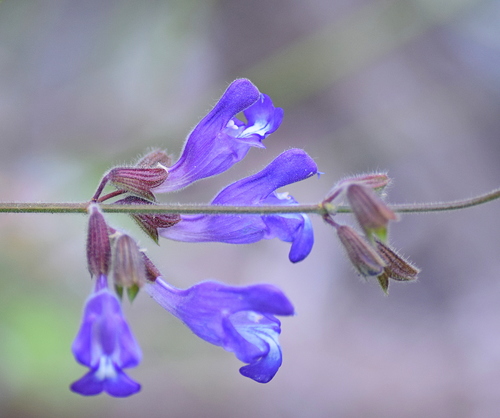
Salvia ringens Sm. is a hardy herbaceous perennial plant that is native to the southern and eastern regions of the Balkan Peninsula. Numerous colonies of this species grow on Mount Olympus, the traditional home of the gods, at elevations reaching up to 6,200 feet, or 1,900 meters. In other locations, it grows in scrub and coniferous woodland at altitudes between 1,600 feet (490 meters) and 4,200 feet (1,300 meters). This species was cultivated in English gardens before 1913, and was described by William Robinson in the twelfth edition of The English Flower Garden, published in 1933. It fell out of common cultivation and attention before it was rediscovered in the late 1990s. Salvia ringens grows into a basal clump of pinnately divided leaves, and the whole clump is typically less than 1 foot in both height and width. Its leaves are dark green with a grayish tint, while the petioles and stems have a distinct wine color that stands out. From summer into autumn, the plant produces tall flowering stems that reach 2 feet in height. These stems hold two to four flowers at the top, arranged in widely spaced whorls, and only a few stems are produced at any one time. The 1.5 inch violet-blue flowers are large and very showy, and are held in a small calyx covered with hairs and glands. Its specific epithet, ringens, refers to the plant’s wide open two-lipped flowers.