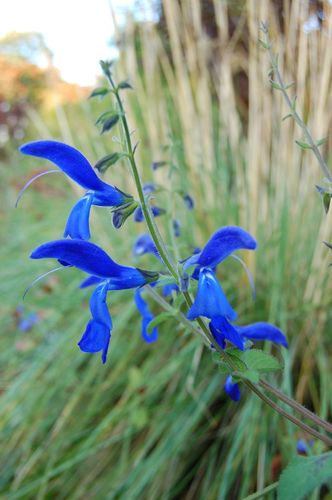
About Salvia patens Cav.
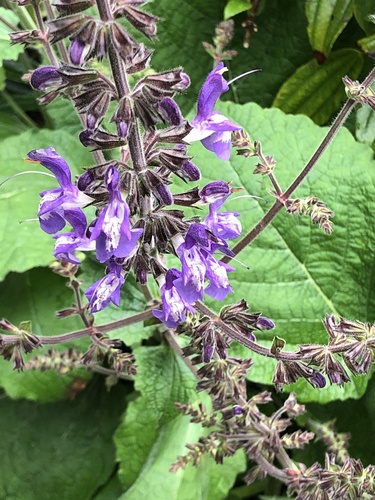
Salvia patens Cav. is a tuberous plant that is easily dug up for overwintering in a greenhouse. Most common varieties grow 30–60 cm (12–24 in) tall and wide, and are covered in mistletoe-green leaves shaped like a halberd. Its inflorescences grow 15 to 30 cm (5.9 to 11.8 in) or longer, rising noticeably above the plant’s leaves. Pure blue flowers that measure 2.6 cm (1.0 in) are spaced along the inflorescence; these flowers are paired with 1.3 cm (0.51 in) green calyxes that enhance their attractiveness. The Latin specific epithet "patens" translates to "spreading". In cultivation, gardeners often grow Salvia patens as an annual because it is sensitive to hard frost, and bedding plants are typically planted out in spring. Cultivated varieties have been developed with flower colors ranging from white to lilac to various shades of blue. Seeds for varieties with richly colored, large flowers have been available from the Netherlands since the 1990s. Both the original species and its cultivar 'Cambridge Blue' have received the Royal Horticultural Society's Award of Garden Merit. In the 1933 edition of The English Flower Garden, William Robinson praised this species, writing that it is "doubtless, the most brilliant in cultivation, being surpassed by and equalled by few other [garden] flowers." A 1991 plant collecting trip to Mexico led by James Compton discovered a 1.8 m (5.9 ft) tall variety with large deep blue flowers, which is now sold commercially under the name 'Guanajuato'.