About Salvia palaestina Benth.
Salvia palaestina Benth. is a herbaceous perennial plant. It is native to a broad region that includes Palestine, Turkey, Syria, Israel, Lebanon, Iraq, Iran, the Sinai peninsula, and northeastern Egypt.
Taxonomy History
George Bentham first named and formally described this species in 1835. Its specific epithet, palaestina, refers to the species' type locality: the mountains between Gaza and Jerusalem, originally cited as "in Palæstinæ montibus inter Gaza et Jerusalem".
Habitat Range
This species can grow in a wide range of different habitats, at elevations between 300 and 1220 m (1,000 to 4,000 ft). It was introduced into horticulture in the 1990s.
Plant Size
Mature plants reach between 0.30 to 0.61 m (1 to 2 ft) in height, with an upright growth habit. Multiple square stems grow from the plant's basal roots.
Leaf Characteristics
Its mid-green leaves are rugose, vary in both shape and size, have light hairs on both leaf surfaces, and contain glands that release a scent when the leaves are rubbed or crushed.
Inflorescence Structure
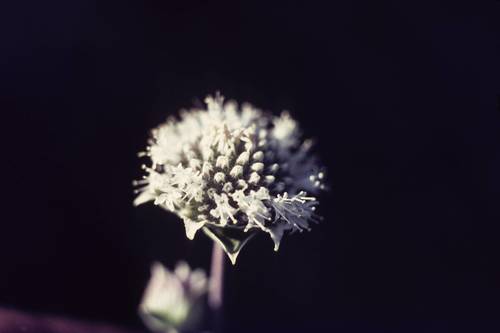
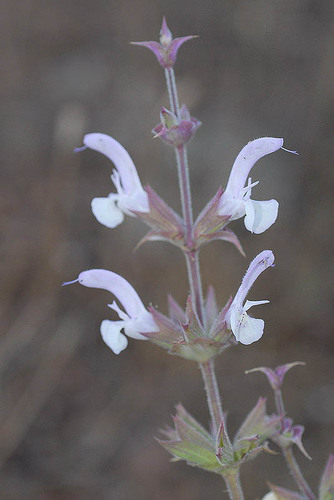
Candelabrum-shaped inflorescences up to 30 cm (12 in) long grow at the tops of the stems, with 4 to 6 flowers per whorl.
Flower Features
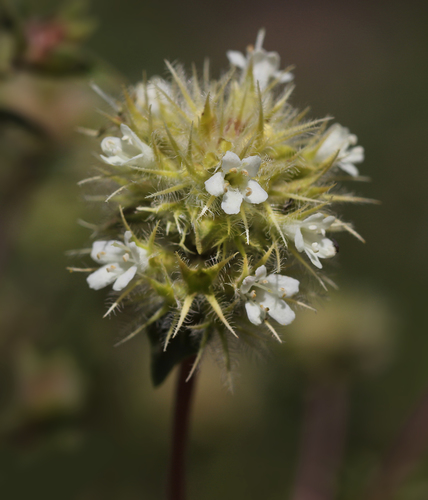
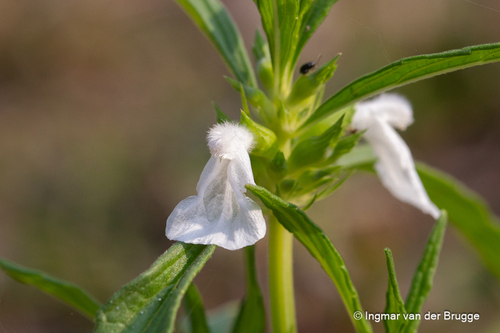
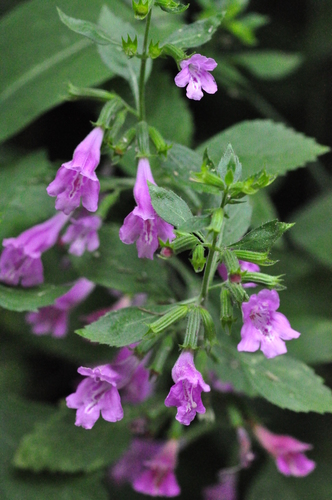
The flowers are straight and tubular, and measure 1.3 cm (0.5 in) long. Their color ranges from white to pale lilac.