About Salvia munzii Epling
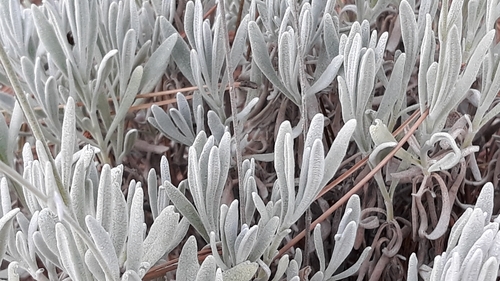
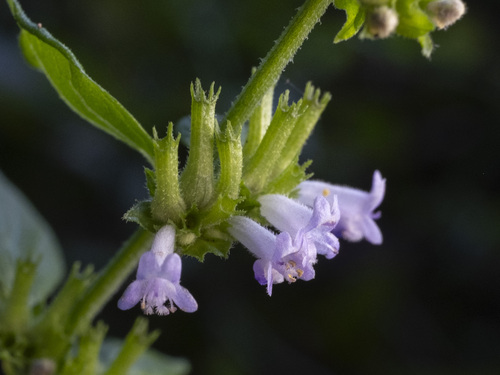
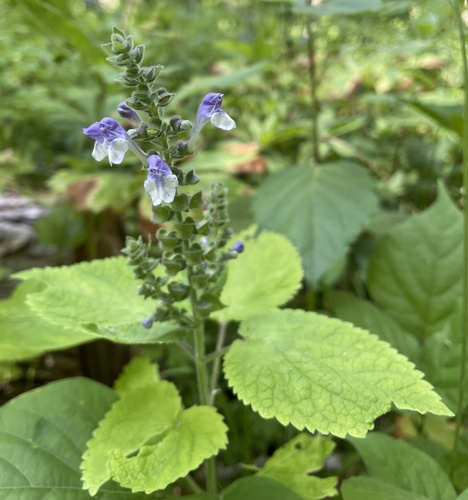
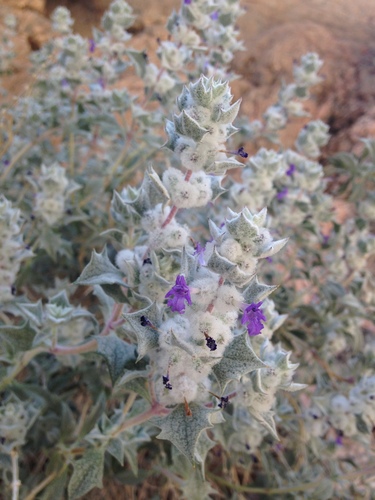
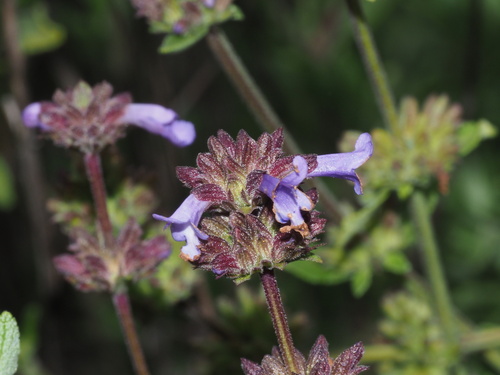
Salvia munzii is a bushy shrub that can grow over 2 metres (6.6 ft) tall. Its branches are covered in hairs. The rough-textured leaves grow up to 5 centimeters long, with dense hairs covering their undersides. Erect inflorescences are made up of many interrupted flower clusters, and each cluster is subtended by a pair of lance-shaped, leaf-like bracts. Each flower has a tubular blue corolla up to 1.5 centimeters long. This species flowers from January to May.
Salvia munzii can be distinguished from Salvia mellifera by its more compact, rounded growth habit, unbranched inflorescence, more obovate-shaped leaves, and particularly the shape of its corolla and stamens. Its corolla is also a uniformly darker blue than that of S. mellifera, and rarely matches S. mellifera in color. S. munzii also flowers much earlier, beginning as early as January. The scent of this plant most closely resembles that of Salvia clevelandii, which also shares similar foliage with it.
In Baja California, this shrub is common. It is found sparsely from Tijuana south to Ensenada, where its distribution becomes more abundant. It grows further south into the northern Central Desert region around the Boojum tree belt in El Rosario, and extends about 25 miles inland. A voucher specimen of this plant listed from the state of Sonora is likely mislabeled, and the record instead refers to the Sonoran Desert region of Baja California; it is unclear if the species actually occurs in the state of Sonora. In California, this species is restricted to the San Miguel Mountains of San Diego County, where it grows on both public and private land. It is generally found in chaparral and coastal scrub habitats. It most often grows in association with Artemisia californica, a co-dominant species in the coastal sage formation, and is frequently found growing alongside Salvia apiana.
This species is well-suited for small gardens and perennial borders, and it attracts hummingbirds and butterflies. Plants typically look their best when their tips are pruned regularly, and they receive watering once a month during the summer. It is tolerant of heavy soil and full sun, and is resistant to frost. Its small leaves can create an interesting visual contrast when grown alongside other sage species.