About Salvia glutinosa L.
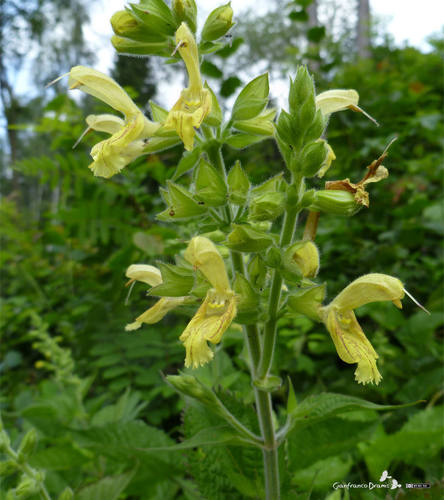
Salvia glutinosa L. grows to approximately 40–60 centimetres (16–24 in) tall. It has erect stems, with bright green hairy leaves that are about 13 cm (5.1 in) long, attached to petioles that measure around 8–10 centimetres (3.1–3.9 in). The leaves are deciduous, toothed, pointed, covered in fine hair (tomentose), and glandular. After the first frosts, the plant's foliage disappears, and it overwinters as dormant buds. All parts of the plant are covered with sticky glandular hairs, which are especially prominent on the lime-green calyces and flowers. This sticky characteristic gives the species its scientific epithet "glutinosa". These sticky hairs likely serve a protective function against predators. Salvia glutinosa is the main host plant of the plant bug Macrotylus quadrilineatus, which feeds on both the plant's juices and small insects that get trapped on the sticky sage. The plant's flowers grow in whorls holding two to six flowers each; individual flowers are pale yellow with maroon speckles. The flowers are supported by tiny persistent bracts and measure 3–5 centimetres (1.2–2.0 in) long, which is quite large for a sage. Each flower has two stamens and a bell-shaped calyx, and the flowering period runs from June to September. One report has stated this species contains salvinorin A, but this finding has not been replicated. A previous study that examined 441 Salvia species from multiple regions only found salvinorin A in Salvia divinorum, a species native to Mexico. Salvia glutinosa is native to Central and East Europe, and West Asia, and is cultivated in gardens. It occurs in forested habitats, including deciduous and mixed woodlands, where it prefers shade or partial shade and calcareous soils. It grows at altitudes ranging from 100 to 1,600 metres (330 to 5,250 ft) above sea level.