About Salvia fruticosa Mill.
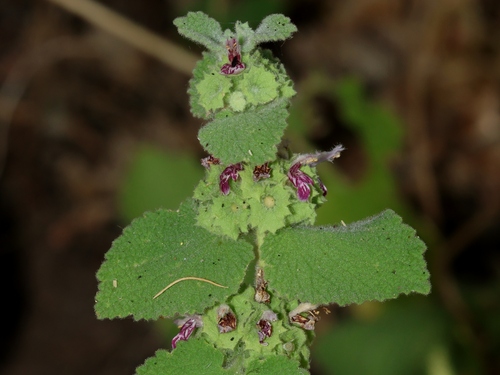
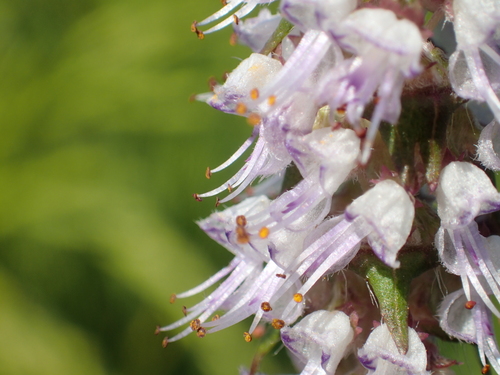
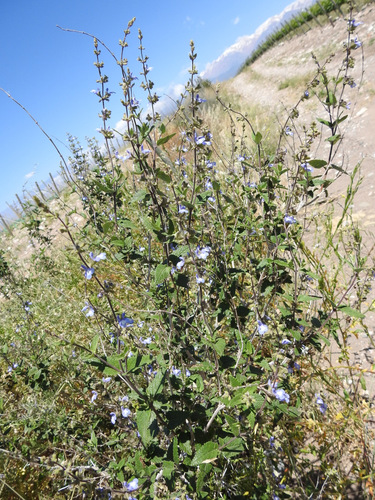
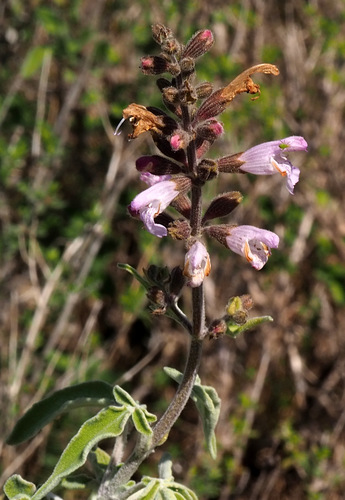
Salvia fruticosa Mill., commonly known as Greek sage, grows 0.6 metres (2 ft) both high and wide, with flower stalks that rise 0.3 m (1 ft) or more above its foliage. The entire plant is covered in hairs, and numerous leaves of varying sizes grow in clusters, giving it a bushy, silvery appearance. Its flowers are pinkish-lavender, about 1.3 centimetres (1⁄2 in) long, and grow in whorls along the inflorescence. Each flower is held in a small, oxblood-red, five-pointed, hairy calyx. This species is native to the eastern Mediterranean, including Southern Italy, the Canary Islands, and North Africa. It is especially abundant in Palestine, Israel, and Lebanon. In its native range, it grows as part of Maquis shrubland and several other open plant communities, and it is not uncommon to find populations made up entirely of S. fruticosa. In its native habitat, this plant frequently develops round woolly galls about 2.5 cm in diameter, which are called 'apples'. Gall formation was originally thought to occur only on Salvia pomifera, which led to the misidentification of many gall-bearing S. fruticosa plants. In 2001, researchers discovered that the galls on S. fruticosa are caused by a previously unknown genus of cynipid gall wasp. This plant has a long history of traditional use in Greece, where it is valued for its beauty, medicinal properties, culinary use, and its production of sweet nectar and pollen. S. fruticosa was depicted in a Minoan fresco dating to around 1400 BCE at Knossos on the island of Crete. The ancient Phoenicians and Greeks likely introduced the species to the Iberian peninsula for cultivation, and remnant populations of these introduced plants still exist in some coastal areas. In Ottoman Palestine, honey bees harvested the flower's pollen to make honey. Today, it is grown as an ornamental flowering shrub. It prefers full sun, well-draining soil, and good air circulation. It is hardy to 20 °F (−7 °C) and is very drought resistant. Its leaves have a high oil content that contains some of the same chemicals found in lavender. Greek sage makes up 50–95% of all dried sage sold in North America, and it is grown commercially to produce its essential oil. It also has a long tradition of use in various Muslim rituals, including ceremonies for newborn children, weddings, and funerals, where it is burnt as incense. A hybrid cross between S. fruticosa and S. officinalis developed in the Middle East is called 'silver leaf sage' or Salvia 'Newe Ya'ar', and it is used in cooking. The soft galls ('apples') that form on the plant are peeled and eaten, and are described as fragrant, juicy, and tasty.