About Salvia farinacea Benth.
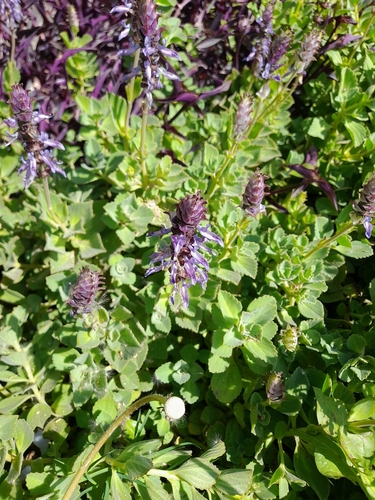
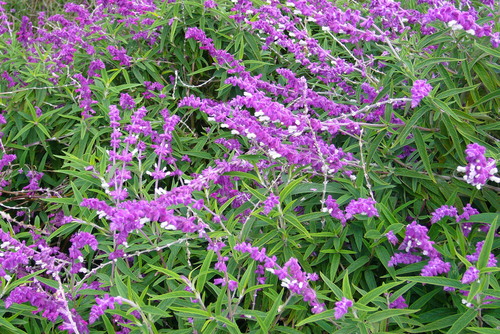
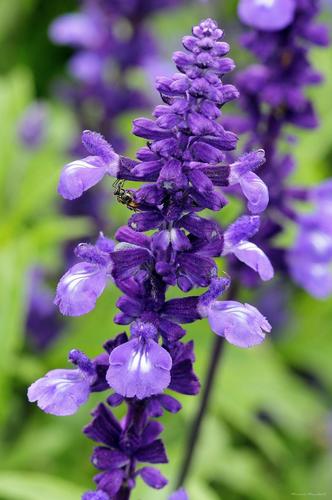
Scientific name: Salvia farinacea Benth. Description: Mealycup sage grows between 60 and 90 cm tall. Its leaf blades vary in shape from ovate-lanceolate to lanceolate. The inflorescence axis has blue hairs, and rarely white hairs. The truncated calyx has very short calyx teeth, which are densely covered in blue or white hairs, making the individual calyx teeth barely recognizable. The bright blue-white flowers are slim and gleaming. The corolla reaches about 2.5 inches in length, and there is no ring-shaped hair strip inside the corolla. Salvia farinacea was first described in 1833 by George Bentham in Labiatarum Genera et Species, page 274. Synonyms for Salvia farinacea Benth. include Salvia linearis Sessé & Moc. and Salvia virgata Ortega. Cultivation: This plant needs full or partial sun, and will grow to 18 inches or taller in good soil. It attracts bees, butterflies, and hummingbirds. It is hardy to USDA Hardiness Zones 8–10. Many varieties are often reported to be hardy to zone 7 when well-sited and left standing over winter, with pruning delayed until late winter or early spring. Hybrids of Longispicata × farinacea are often reliably hardy to zone 7. This plant flowers from June through frost, or as early as April for mature clumps. In the southern United States, it can grow into a stunning, long-lived specimen as a solitary plant or when grown en masse. In temperate latitudes, it is cultivated as an annual plant, and used as an ornamental plant in parks and gardens, especially in summer seasonal plantings. It can also be used as a cut flower. Several cultivars are in cultivation, including 'Blue Bedder', 'Victoria' which bears intense violet-blue flowers, and 'Strata' which bears white and blue flowers. Crosses between Salvia farinacea and Salvia longispicata (Salvia longispicata × Salvia farinacea) are widely sold as ornamental plants, including 'Indigo Spires' and 'Mystic Spires Blue'.