About Salvia apiana Jeps.
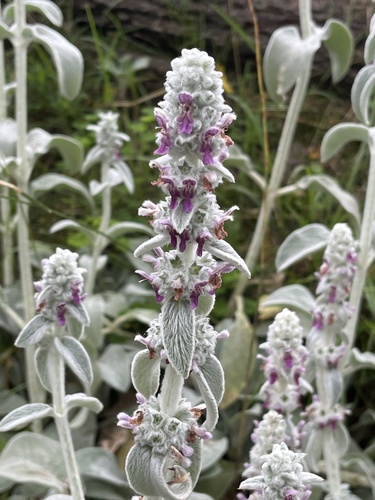
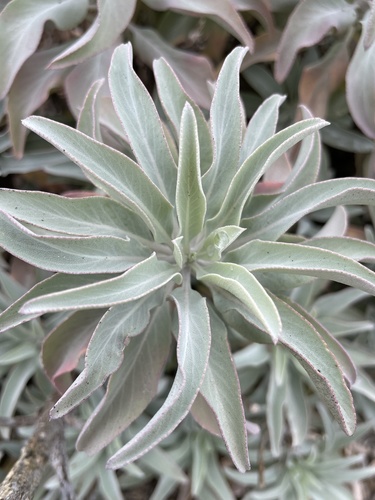
Salvia apiana Jeps., commonly known as Californian white sage, is an evergreen shrub. It grows to 1.3 to 1.5 metres (4.3 to 4.9 ft) tall, and reaches up to 1.3 metres (4.3 ft) wide. Its whitish leaves are 3 to 9 cm (1.2 to 3.5 in) long, persist year-round, grow in opposite arrangements, and have crenulate margins. The leaves are thickly covered in hairs connected to oil glands; when rubbed, oils and resins are released that produce a strong aroma. This plant’s specific epithet apiana refers to the fact that its flowers are very attractive to bees. In spring, several 1 to 1.3 metres (3.3 to 4.3 ft) flower stalks, sometimes pinkish in color, grow above the plant’s foliage; the flowers range in color from white to pale lavender.
Californian white sage is a common plant that grows on dry slopes at elevations below 1,500 metres (4,900 ft), ranging from Southern California to Baja California. It is found in coastal sage scrub, chaparral, and yellow-pine forests, and requires well-drained dry soil, full sun, and very little water to grow.
A wide variety of pollinators are attracted to its flowers, including bumblebees, carpenter bees, Bombyliidae, and hummingbirds. Most of these pollinator species are ineffective at pollinating the plant; only three carpenter bee species and one bumblebee species regularly carry out successful pollination.
Pacific coast Native American peoples of the United States widely use Salvia apiana. Its seeds are a traditional flavoring for pinole, a staple maize-based food. The Cahuilla people traditionally harvest large quantities of its seed, mixing it with wheat flour and sugar to make gruel and biscuits. Leaves and stems of Salvia apiana are a traditional food for the Chumash people and their neighboring communities. For healing practices, several tribes have traditionally used the plant’s seeds to remove foreign objects from the eye, a use similar to how Clary sage seeds are employed in Europe. Cahuilla women traditionally use a tea made from the plant’s roots to support healing and strength after childbirth. Several Native American cultures also use different parts of the plant in ritual purification. Currently, white sage is overharvested for commercial sale, where it is used to make smudge products, incense sticks, and incense cones.
In cultivation, Salvia apiana prefers a sunny location, well-draining soil, and good air circulation. It hybridizes easily with other Salvia species, most notably Salvia leucophylla and Salvia clevelandii.