About Salvia albicaulis Benth.
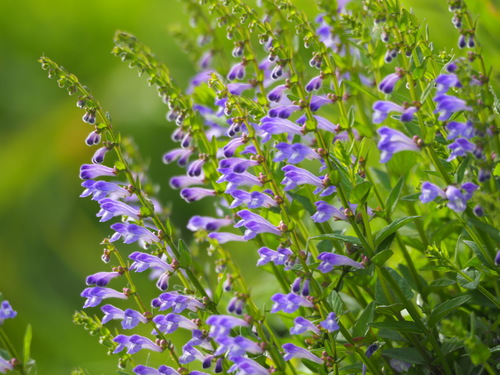
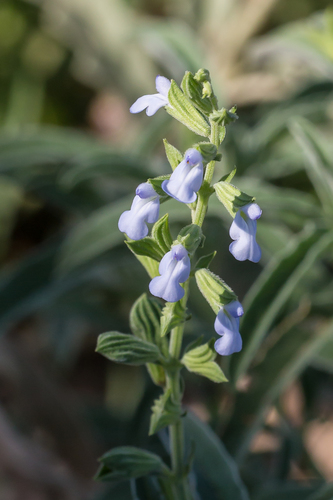
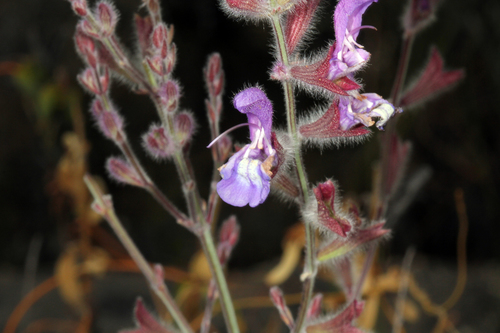
Salvia albicaulis Benth. is a much-branched perennial shrub that typically grows up to 50 cm tall, though it may reach greater heights. Its species epithet albicaulis translates to "white-stemmed" in Latin, and this is the plant's most distinguishing feature: its sharply quadrangular stems are white, covered in a dense layer of very fine, short hairs. The leaves of Salvia albicaulis are simple, thick, and leathery in texture. Leaf shape varies widely, ranging from obovate to nearly circular or spatula-shaped, with margins that are irregularly scalloped to toothed. Leaves grow up to 3.5 cm long and 2.8 cm wide. The upper leaf surface is hairless or sparsely bristly, while the lower surface is white, densely hairy, and marked by a prominent network of veins. The leaf stalk (petiole) reaches up to 1 cm in length. The inflorescence is highly branched, with up to eight closely spaced whorls, each holding two flowers, or occasionally three. The floral leaves are lance-shaped and drop off early. Bracts are present. Flower stalks (pedicels) grow up to 3 mm long. The calyx is broadly bell-shaped, up to 12 mm long, has twelve veins, and is densely covered in long, white hairs. It expands very little as the fruit develops. The upper lip of the calyx has three teeth, with the central tooth shorter than the two lateral teeth; the lower lip holds two narrow, lance-shaped, sharply pointed teeth that are about 4 mm long. The corolla is purplish, a trait that further distinguishes this species from related plants like Salvia chamelaeagnea. The corolla is up to 24 mm long, with a tube that measures 10–12 mm long. The upper hood of the corolla is curved. The staminal connective is about 12 mm long, and the filaments are approximately 5 mm long. The lower pollen sacs are free, sterile, and irregularly shaped. The fruit is made up of rounded, three-angled brown nutlets that measure roughly 3 × 2 mm. Salvia albicaulis flowers from November to May.