About Salvadora persica L.
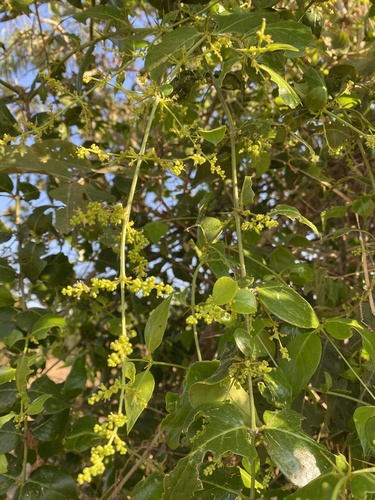
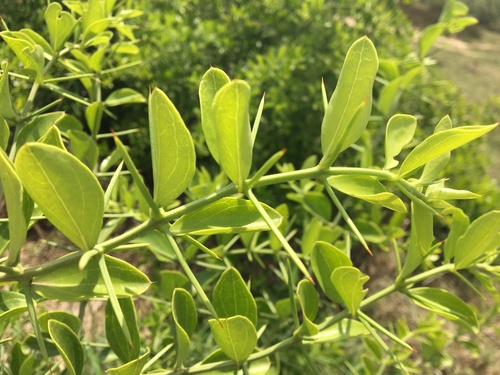
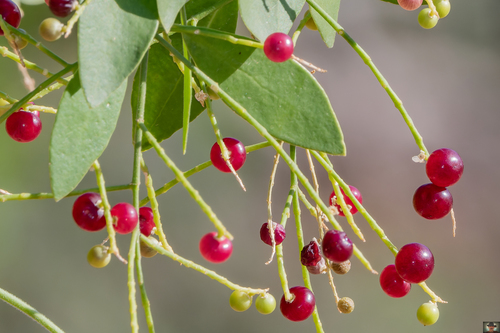
Salvadora persica L. is a small tree or shrub that grows 6 to 7 metres (20 to 23 ft) tall, with a characteristically crooked trunk. Its bark is scabrous, cracked, and whitish, with pendulous branch tips. The root bark matches the color of sand, and its inner surfaces are an even lighter shade of brown. The plant carries a pleasant fragrance similar to cress or mustard, and has a warm, pungent taste. It bears small red edible fruits that grow in clusters; the fruits are juicy but pungent. Its leaves are dark green, round, and fleshy. This species is native to the Middle East, North Africa, and India, where it grows on desert floodplains, riverbanks, and grassy savannahs. It has a high tolerance for salty soils, and can survive with as little as 200 millimetres (8 inches) or less of mean annual rainfall, though it prefers consistent access to groundwater. Sticks of Salvadora persica, widely known as miswak, are used for cleaning teeth across the Arabian Peninsula, Iranian Plateau, and the broader Muslim world. Toothbrushes made from its roots and small branches around 3 to 5 mm in diameter have been used for over 1000 years, especially by Islamic communities in India, Arabia, and Africa. Multiple compounds found in the plant's bark and wood have been proposed as helpful for preventing dental caries (cavities), including antimicrobial agents that suppress bacterial growth and plaque formation. The fresh leaves of Salvadora persica can be eaten as part of salads, and are also used in traditional medicine. Its small, fragrant flowers are used as a stimulant, and have a mild purgative effect. The small berries are eaten both fresh and dried. The plant's wood is used to make charcoal and as firewood. In Namibia, this species (called mustard bush there) is used as drought-resistant cattle fodder. Oil extracted from its seeds can be used as a detergent. As of 2009, Botanic Gardens Conservation International holds a total of eight conserved Salvadora persica plants.