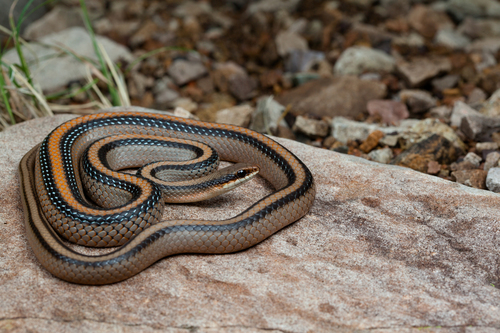
About Salvadora grahamiae Baird & Girard, 1853
Salvadora grahamiae, formally described by Baird & Girard in 1853, can reach a total length of 47 inches (120 centimeters) when fully grown, including the tail. This species has eight upper labial scales, and its posterior chin shields either touch one another or are separated by just one small scale. This species is distributed across the south-central United States and northern to eastern Mexico: in the United States, it occurs in the states of Arizona, New Mexico, and Texas; in Mexico, it is found in the states of Chihuahua, Coahuila, Querétaro, Tamaulipas, and Veracruz. It lives in a wide range of habitat types, including forest, savanna, shrubland, grassland, and desert, at elevations ranging from sea level up to 1,980 meters (6,500 feet). Salvadora grahamiae is oviparous. Females lay their eggs between April and June each year, and a clutch contains 5 to 10 eggs.